
Vinegar production requires more than a filling machine. To achieve stable product quality and efficient packaging, manufacturers need a complete processing and bottling system that connects water treatment, ingredient mixing, filtration, product storage, bottle preparation, filling, capping, labeling, and packaging.
A PET bottle vinegar production line provides an integrated solution for producing and packaging products such as white vinegar and colored vinegar.
This article introduces a typical 500L/H vinegar production line designed for PET bottles, with a production process that includes concentrated vinegar dilution, mixing, filtration, storage, bottle blowing, washing, filling, capping, labeling, coding, and carton packaging.
The system is suitable for manufacturers planning a new vinegar production facility or upgrading an existing bottling operation.
What Is a PET Bottle Vinegar Production Line?
A PET bottle vinegar production line is an integrated system used to process, prepare, fill, and package vinegar products into PET bottles.
Depending on the product formulation, the production process can include concentrated vinegar dilution, water mixing, color adjustment, filtration, finished product storage, bottle preparation, filling, capping, labeling, coding, and packaging.
For a typical production project, concentrated vinegar can be mixed with treated water and other ingredients according to the required product formula.
For example, the process may include:
Concentrated Vinegar + Water + Caramel Mixing → Vinegar Dilution → Filtration → Storage → Bottle Preparation → Bottle Washing → Filling → Capping → Labeling → Coding → Carton Packaging
This type of production line can be configured for white vinegar, colored vinegar, and other liquid condiment products.
Production Capacity and Bottle Format
The production line described in this solution is designed for approximately 500 liters of finished vinegar per hour.
The primary bottle format is a 1-liter PET bottle.
The actual filling speed can vary depending on the bottle size, filling volume, product characteristics, and packaging configuration.
For manufacturers, selecting the right production capacity is important because all major equipment—including mixing tanks, storage tanks, filtration equipment, filling machines, and conveyors—should be properly matched.
A balanced production line helps avoid bottlenecks between processing and packaging stages.
Complete Vinegar Production Process
A complete vinegar bottling line can be divided into several major stages.
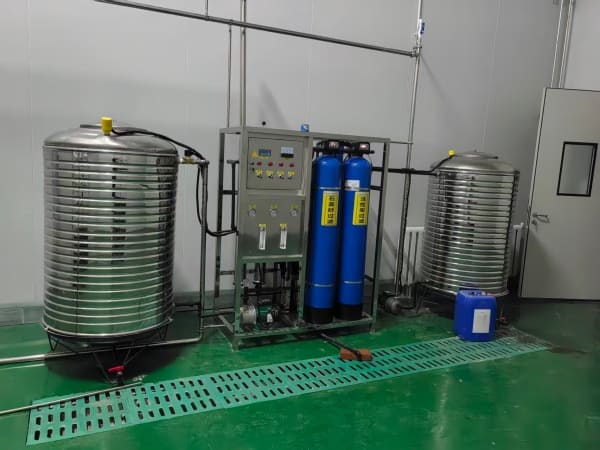
1. Water Treatment
Water quality is an important part of vinegar production.
The water treatment system prepares the process water used for product dilution and production.
A typical water treatment section may include:
- Raw water storage tank
- Quartz sand filter
- Activated carbon filter
- Water softening system
- Antiscalant system
- Reverse osmosis system
- Security filter
- Water quality monitoring system
- Pure water storage tank
- Constant pressure water pump
The purpose of water treatment is to provide stable and properly prepared water for the production process.
2. Vinegar Dilution and Mixing System
After the process water is prepared, concentrated vinegar and other ingredients can be mixed according to the product formula.
For colored vinegar, ingredients such as concentrated vinegar, water, and caramel may be combined to achieve the required color and concentration.
For white vinegar, the formulation and mixing process can be adjusted according to the product requirements.
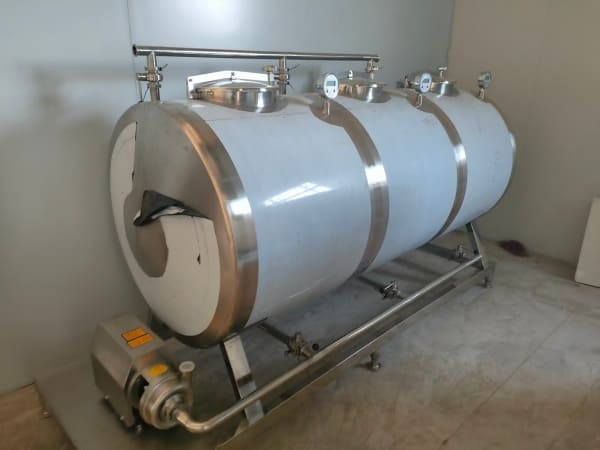
The mixing section may include stainless steel dilution and mixing tanks equipped with:
- Agitation systems
- Manholes
- Breathing filters
- Liquid level indicators
- CIP cleaning connections
- Sanitary inlet and outlet connections
Proper mixing helps improve product consistency and ensures that ingredients are evenly distributed.
In this type of production line, 3000L stainless steel mixing tanks can provide sufficient buffering capacity for continuous production.
3. Vinegar Filtration System
After mixing, the vinegar product passes through a filtration stage.
Filtration helps remove unwanted impurities before the finished product enters the storage and filling process.
A typical filtration system may include:
- Duplex filters
- Bag filters
- Product transfer pumps
Different filtration configurations can be selected according to product requirements.
The use of multiple filtration stages can help support stable product quality while maintaining continuous production.
4. Finished Vinegar Storage
After filtration, the finished vinegar is transferred to storage tanks before filling.
Storage tanks act as a buffer between the processing section and the bottling section.
Typical finished product tanks are equipped with:
- Stainless steel construction
- Manholes
- Breathing devices
- Liquid level monitoring
- CIP cleaning ports
- Sanitary connections
Proper storage capacity helps maintain continuous production and allows the filling system to operate efficiently.
PET Bottle Preparation System
5. Automatic PET Bottle Blowing
For manufacturers producing their own bottles, an automatic bottle blowing system can be integrated into the production line.
PET preforms are heated and blown into finished bottle shapes.
A typical PET bottle blowing system may include:
- Automatic PET bottle blowing machine
- Preform feeding system
- Bottle molds
- High-pressure air compressor
- High-pressure air storage tank
- Low-pressure air compressor
- Air dryer
- Air filtration equipment
The bottle blowing system allows manufacturers to produce PET bottles directly at the factory.
This can reduce dependence on external bottle suppliers and improve control over bottle availability.
However, some manufacturers may choose to purchase ready-made bottles instead, depending on production volume and investment plans.
Vinegar Filling and Packaging System
6. Bottle Conveying and Washing
Before filling, PET bottles are transferred to the washing and filling section.
The bottle conveying system helps move bottles continuously between different machines.
A bottle washing machine can be used to clean bottles before filling.
Depending on the production requirements, the bottle washing system can include multiple washing heads and bottle handling components designed according to the bottle shape.
Clean bottle handling is an important step before the filling process.
7. PET Bottle Vinegar Filling Machine
The vinegar filling machine is one of the most important pieces of equipment in the complete production line.
For a 500L/H production solution, a multi-head filling machine can be used to provide stable and accurate liquid filling.
The system can be configured with:
- Multiple filling heads
- Quantitative filling control
- Stainless steel product-contact components
- Bottle conveyors
- Protective machine covers
- Adjustable filling parameters
The final filling machine should be selected according to:
- Bottle size
- Production capacity
- Product viscosity
- Filling accuracy requirements
- Automation level
For 1L PET bottles, the filling speed can be designed to match the capacity of the upstream production system and downstream packaging equipment.
8. Bottle Inspection
After filling, bottles can pass through an inspection stage.
A visual inspection station helps operators check bottle appearance and product filling conditions.
Depending on the required automation level, additional inspection equipment can also be integrated into the production line.
9. Bottle Capping
After filling, bottles are transferred to the capping machine.
The capping system applies and tightens caps to seal the finished product.
Stable capping performance is important for:
- Product safety
- Leak prevention
- Transportation
- Product appearance
- Shelf storage
The cap type and bottle design should be confirmed before finalizing the capping equipment.
10. Bottle Drying
A bottle drying system can be installed after filling and capping.
Air knives or blowers remove moisture from the outside of the bottles before labeling.
This helps improve labeling performance and keeps the packaging appearance clean.
[Image Placeholder: Bottle air drying system]
Suggested Alt Text: Air knife bottle drying machine for PET bottle packaging
11. Automatic Labeling
Labeling gives the finished vinegar bottle its final product identity.
For round PET bottles, a self-adhesive labeling machine can be used.
The labeling system can include PLC-based control and adjustable settings for different bottle sizes.
The final labeling solution should be selected according to:
- Bottle shape
- Label material
- Label position
- Production speed
- Packaging design
12. Date Coding and Product Identification
A coding machine can print important product information on the packaging.
This may include:
- Production date
- Batch number
- Expiration date
- Product code
Laser coding is one possible solution for manufacturers that require permanent and high-speed product marking.
13. Carton Packaging
The final stage of the production line is secondary packaging.
Finished bottles can be packed into cartons for transportation and distribution.
Depending on the production requirements, the packaging section may include:
- Bottle conveyors
- Manual or automatic packing
- Carton sealing machines
- Case coding systems
For small and medium-capacity production lines, semi-automatic carton sealing equipment may provide a practical packaging solution.
CIP Cleaning System for Vinegar Production
Cleaning is an essential part of food and condiment production.
A CIP (Clean-in-Place) system allows production equipment to be cleaned internally without frequent manual disassembly.
The CIP system can be used for:
- Mixing tanks
- Storage tanks
- Product pipelines
- Pumps
- Filling-related product pipelines
A typical CIP system may include cleaning solution tanks, heating systems, circulation pumps, and return pumps.
For this production line, stainless steel cleaning tanks and high-capacity return pumps can be used to support efficient cleaning operations.
A properly designed CIP system helps manufacturers improve hygiene management and reduce cleaning downtime.
Engineering Installation and Auxiliary Systems
A complete vinegar production line requires more than individual machines.
The equipment must be properly connected through pipelines, conveyors, electrical systems, and automation controls.
Supporting engineering systems may include:
- Product pipelines
- Water pipelines
- Stainless steel conveyors
- Variable-speed drive units
- Electrical control cabinets
- Electrical cables
- Cable trays
- Compressed air pipelines
- Installation and commissioning services
An integrated engineering solution helps ensure that the processing and packaging sections operate as one coordinated production system.
Key Benefits of a PET Bottle Vinegar Production Line
A complete vinegar production line offers several advantages for manufacturers.
Integrated Production Process
Water treatment, mixing, filtration, storage, bottle preparation, filling, and packaging can be connected into one production process.
Flexible Product Production
The system can be designed for different vinegar products, including white vinegar and colored vinegar.
Improved Product Consistency
Controlled mixing and filtration help support stable product quality.
PET Bottle Packaging
PET bottles are lightweight, durable, and convenient for transportation.
Scalable Production
The production line can be designed according to current capacity requirements while considering future expansion.
Reduced Manual Handling
Automation and conveyor systems help improve production efficiency and reduce unnecessary manual operations.
How to Choose the Right Vinegar Production Equipment
Before investing in a vinegar production line, manufacturers should clearly define their production requirements.
Important factors include:
Product Type
Will you produce white vinegar, colored vinegar, fruit vinegar, cooking vinegar, or multiple products?
Production Capacity
How many liters or bottles do you plan to produce per hour?
Bottle Format
What bottle size and shape will be used?
Product Formula
Will concentrated vinegar be diluted and blended on-site?
Automation Level
Do you require semi-automatic or fully automatic production?
Factory Layout
How much installation space is available?
Future Expansion
Will production capacity increase in the future?
Answering these questions before equipment selection can help manufacturers design a more efficient and cost-effective production solution.
Conclusion
A PET bottle vinegar production line combines multiple processing and packaging stages into one complete manufacturing solution.
From water treatment and vinegar dilution to filtration, storage, bottle preparation, filling, capping, labeling, coding, and carton packaging, every stage plays an important role in the final product.
For a 500L/H production capacity, manufacturers can select a production line configuration that balances investment cost, automation level, product quality, and future expansion requirements.
The best vinegar production solution should be designed around the actual product formula, production capacity, PET bottle specifications, and factory conditions.
By integrating processing equipment with filling and packaging systems, manufacturers can build a reliable and efficient vinegar production facility for local or international markets.
FAQ
1. What is included in a vinegar production line?
A complete vinegar production line can include water treatment equipment, mixing tanks, filtration systems, storage tanks, bottle blowing equipment, bottle washing machines, filling machines, capping machines, labeling machines, coding equipment, conveyors, and packaging machines.
2. Can the same production line produce white vinegar and colored vinegar?
Yes. A properly designed mixing and processing system can be configured for different vinegar formulations. Cleaning procedures and production scheduling should be considered when switching between products.
3. What bottle size can a vinegar filling machine handle?
The filling machine can be customized according to bottle size. Common formats include 500ml, 1L, and other PET bottle sizes.
4. Do I need a bottle blowing machine?
Not necessarily. Manufacturers can either produce PET bottles on-site using a bottle blowing machine or purchase ready-made PET bottles from an external supplier.
5. Why is filtration important in vinegar production?
Filtration helps remove impurities and supports stable product quality before the vinegar enters the filling stage.
6. What is the production capacity of this vinegar line?
The example production solution is designed for approximately 500 liters per hour, but the final capacity can be customized according to the manufacturer’s requirements.
7. Is a CIP cleaning system necessary?
For integrated food and condiment production equipment, a CIP system can improve cleaning efficiency and help maintain hygienic processing conditions.
8. Can the vinegar production line be customized?
Yes. Equipment configuration can be customized according to product type, production capacity, bottle specifications, automation requirements, and factory layout.