
Tomato paste is widely used in households, restaurants, food processing factories, and catering applications. To produce stable and consistent tomato paste, manufacturers need more than a single filling machine. The complete process requires reliable equipment for raw material preparation, pulping, concentration, mixing, filtration, and packaging.
A tomato paste production line integrates these processing stages into one coordinated system.
This article introduces a typical 500kg/H tomato paste production solution designed for 5kg bag packaging. The production line is suitable for small and medium-sized tomato paste manufacturers, especially for projects requiring a practical and cost-effective production configuration.
The complete system can process tomatoes into pulp, concentrate the product, prepare the final paste, and package it into bags for commercial distribution.
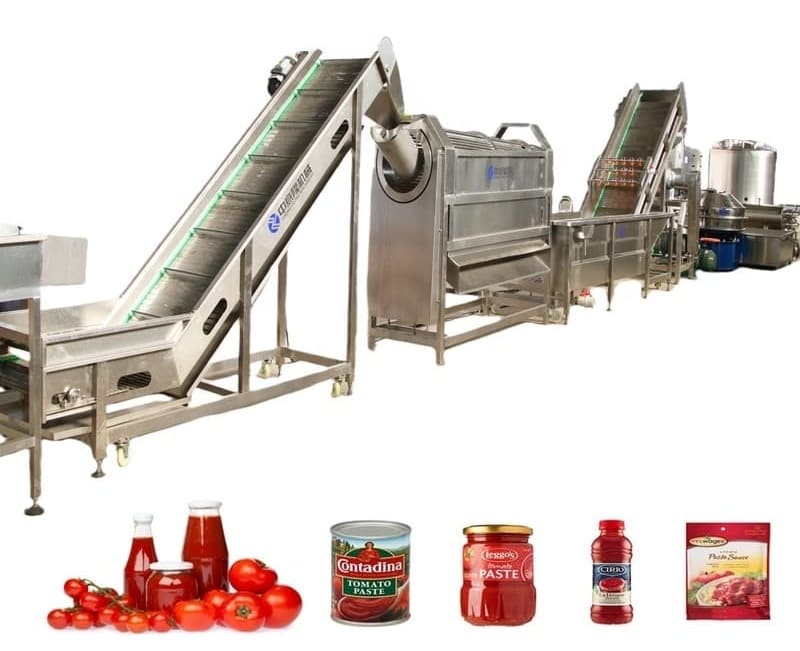
What Is a Tomato Paste Production Line?
A tomato paste production line is a complete processing system used to convert fresh tomatoes or tomato-based raw materials into finished tomato paste.
Depending on the production process and final product requirements, the line may include:
- Raw material preparation
- Tomato crushing
- Pulping
- Temporary storage
- Product transfer
- Concentration
- Mixing and cooking
- Filtration
- Filling
- Final packaging
Each stage plays an important role in maintaining product consistency and production efficiency.
For small and medium-capacity projects, the equipment configuration can be designed according to the required hourly output and packaging format.
This example production solution is designed for approximately 500kg per hour, with 5kg bag packaging as the final product format.
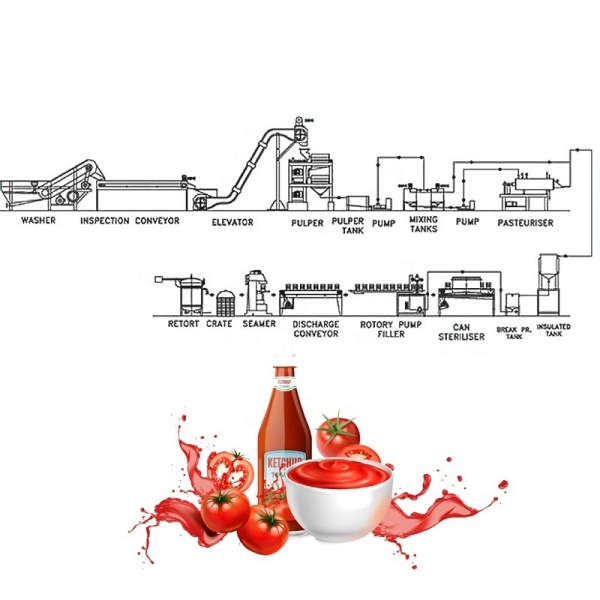
Tomato Paste Production Process
A typical production process can include the following stages:
Fresh Tomato Preparation → Crushing and Pulping → Buffer Storage → Concentration → Mixing and Cooking → Filtration → Filling → Finished Product Packaging
The actual process can be adjusted according to the raw materials, product formula, concentration requirements, and packaging method.
1. Raw Material Pre-Treatment
The first stage of tomato paste production is raw material preparation.
Fresh tomatoes need to be processed into tomato pulp before entering the concentration stage.
A pre-treatment system can include crushing and pulping equipment designed to separate tomato pulp from unwanted skins and seeds.
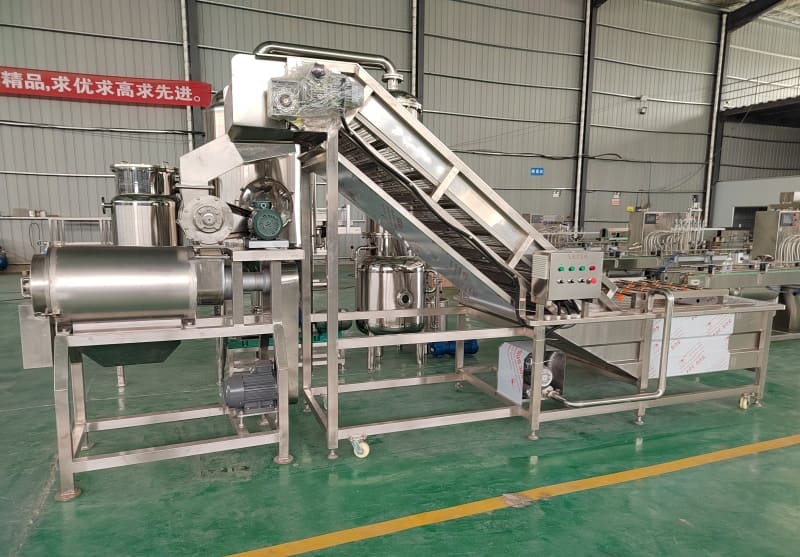
For this production line, a double-channel pulping machine is used for the initial tomato processing stage.
Double-Channel Pulping Machine
The pulping equipment combines crushing and pulping functions.
The upper section is used for crushing, while the lower section processes the material into pulp.
This type of equipment can be used for tomatoes and other fruit and vegetable products, including:
- Tomatoes
- Apples
- Pears
- Berries
- Other pulpy fruits and vegetables
The processing capacity of the equipment is approximately 0.5 tons per hour.
Using integrated crushing and pulping equipment can simplify the initial processing stage and improve production efficiency.
2. Buffer Storage and Product Transfer
After pulping, the tomato pulp is transferred to the next processing stage.
A buffer tank provides temporary storage and helps maintain continuous product flow between different machines.
The system can include:
- Stainless steel buffer tank
- Product transfer pump
- Food-grade pipelines
The buffer system helps reduce interruptions between pulping and concentration.
For tomato paste production, stable material transfer is important because inconsistent product flow can affect downstream processing efficiency.
Tomato Paste Concentration System
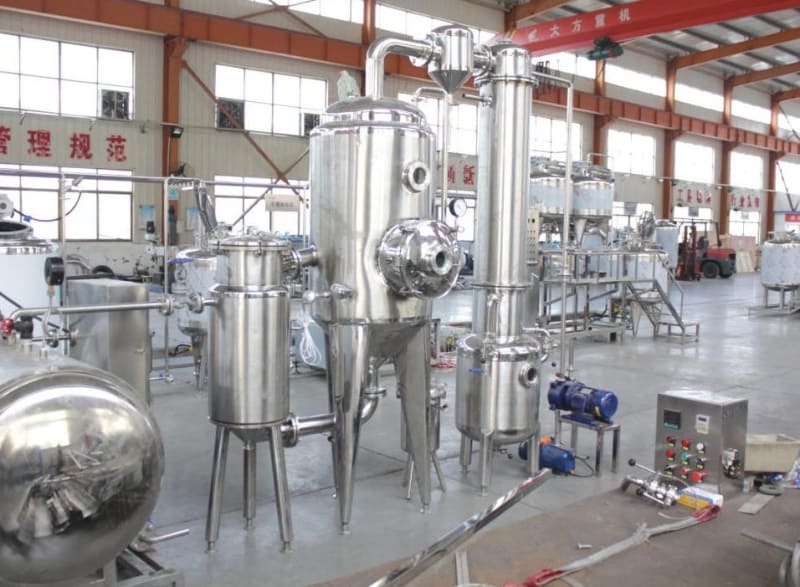
3. Single-Effect Concentrator
Concentration is one of the most important stages in tomato paste production.
Fresh tomato pulp contains a high percentage of water. To produce tomato paste, part of this water must be removed to increase the concentration of the product.
A single-effect concentrator can be used for this process.
The system operates under vacuum conditions, allowing concentration at controlled temperatures.
Typical operating parameters may include:
- Vacuum operation
- Controlled extraction temperature
- Adjustable concentration temperature
- Heating system
- Condensation system
- Agitation system
For this production solution, the concentrator has a capacity of approximately 300 liters.
The concentration temperature can be controlled within a suitable processing range to meet production requirements.
Vacuum concentration can help reduce the boiling temperature compared with atmospheric processing, allowing manufacturers to control the concentration process more effectively.
4. Product Transfer After Concentration
After concentration, the tomato paste needs to be transferred to the next processing equipment.
A stainless steel screw pump can be used to handle the product.
Because tomato paste becomes thicker after concentration, the transfer system should be selected according to the product’s viscosity and processing requirements.
Proper pump selection helps maintain stable material flow and reduces unnecessary production interruptions.
Tomato Paste Mixing and Cooking
5. Jacketed Mixing Kettle
After concentration, the tomato paste may enter a jacketed mixing and cooking kettle for further processing.
The jacketed kettle can be equipped with:
- Stainless steel construction
- Heating jacket
- Agitation system
- Scraper agitator
- Steam heating system
The scraper agitator helps reduce product adhesion to the inner tank surface during heating and mixing.
This is particularly important for concentrated and relatively high-viscosity products such as tomato paste.
The final processing conditions should be adjusted according to the product formulation and required consistency.
6. Final Product Filtration
Before filling, the processed tomato paste passes through a filtration stage.
A pipeline filter can be installed to help remove unwanted particles from the product before packaging.
Filtration is a simple but important part of the production process.
It helps protect downstream filling equipment and supports more consistent finished product quality.
The filter housing and product-contact components should use food-grade stainless steel materials.
Tomato Paste Filling and Packaging
7. 5kg Bag Filling System
After processing and filtration, the finished tomato paste is transferred to the filling section.
This production solution is designed for 5kg bag packaging.
Bag packaging is commonly used for:
- Food service
- Restaurants
- Catering companies
- Food processing factories
- Wholesale distribution
- Commercial kitchens
Compared with small retail packages, 5kg packaging can be suitable for customers who require larger product volumes.
The filling system can be configured according to the packaging material, filling method, and automation requirements.
For this production line, a semi-automatic filling solution can provide a practical option for small and medium-capacity production.
Main Equipment in a 500kg/H Tomato Paste Production Line
A typical production line can include the following equipment.
| Production Section | Main Equipment |
|---|---|
| Raw Material Processing | Double-channel pulping machine |
| Buffer System | Stainless steel buffer tank |
| Product Transfer | Screw pumps |
| Concentration | Single-effect vacuum concentrator |
| Mixing and Cooking | Jacketed kettle with agitator |
| Filtration | Pipeline filter |
| Packaging | Semi-automatic bag filling machine |
The final equipment configuration can be adjusted according to the customer’s production requirements.
Why Choose an Integrated Tomato Paste Production Line?
Improved Production Efficiency
Connecting multiple processing stages helps create a continuous production workflow.
Instead of manually transferring products between individual machines, pumps and pipelines can connect the major processing stages.
Better Product Consistency
Controlled pulping, concentration, mixing, and filtration can help manufacturers maintain more consistent product quality.
Suitable for Different Production Scales
A tomato paste processing line can be designed for small, medium, or large production capacities.
The 500kg/H configuration provides a practical starting point for manufacturers entering the commercial tomato paste market.
Flexible Packaging Options
Although this solution focuses on 5kg bag packaging, the processing section can be combined with different packaging equipment depending on market requirements.
Easier Factory Management
An integrated production line makes it easier to organize equipment layout, material flow, and production operations.
Important Factors When Designing a Tomato Paste Production Line
Before purchasing equipment, manufacturers should define their production requirements.
Raw Material Type
Will the factory process fresh tomatoes, tomato pulp, or pre-concentrated tomato products?
This affects the required processing equipment.
Production Capacity
How many kilograms of tomato paste should be produced per hour or per day?
The equipment capacity should be properly matched throughout the production line.
Final Product Concentration
Different tomato paste products may require different concentration levels.
The concentration equipment should be selected according to the final product specifications.
Packaging Format
The packaging system should match the target market.
Common options may include:
- Sachets
- Small pouches
- 1kg bags
- 5kg bags
- Cans
- Glass jars
- Other industrial packaging formats
Automation Requirements
Small production facilities may prefer semi-automatic equipment to control investment costs.
Larger factories may require fully automatic processing and packaging systems.
Factory Layout
Equipment layout should consider:
- Material flow
- Operator access
- Cleaning requirements
- Utility connections
- Future expansion
A properly planned layout can improve production efficiency and simplify daily operation.
A Practical Solution for Tomato Paste Manufacturers
For manufacturers entering the tomato paste industry, equipment selection should be based on actual production requirements rather than simply choosing the largest or most automated equipment.
A 500kg/H tomato paste production line can provide a balanced solution for projects that require moderate production capacity and controlled investment.
The combination of pulping, concentration, mixing, filtration, and bag filling allows manufacturers to establish a complete processing workflow.
The production line can also be customized according to:
- Raw material characteristics
- Required product concentration
- Production capacity
- Packaging weight
- Automation level
- Factory space
This flexibility makes customized equipment design particularly important for tomato paste processing projects.
Conclusion
A complete tomato paste production line integrates several important processing stages, from raw material preparation to final packaging.
For a 500kg/H production capacity, the system can include tomato crushing and pulping, buffer storage, vacuum concentration, product mixing and cooking, filtration, and semi-automatic 5kg bag filling.
Each piece of equipment should be properly matched to ensure stable product flow throughout the production process.
When planning a tomato paste factory, manufacturers should consider not only the production capacity but also raw materials, product concentration, packaging format, automation requirements, and future expansion.
A customized tomato paste production solution can help manufacturers build a more efficient and reliable processing operation.
FAQ
1. What is included in a tomato paste production line?
A tomato paste production line can include pulping machines, buffer tanks, transfer pumps, concentrators, mixing kettles, filtration equipment, and filling machines.
2. What is the production capacity of this tomato paste line?
This example production solution is designed for approximately 500kg per hour.
3. Can the line process fresh tomatoes?
Yes. The raw material pre-treatment section includes crushing and pulping equipment suitable for tomatoes and other pulpy fruits and vegetables.
4. Why is vacuum concentration used for tomato paste?
Vacuum concentration helps remove water from tomato pulp under controlled conditions and is used to increase the concentration of the final product.
5. What packaging format is used in this production line?
This solution is designed for 5kg bag packaging.
6. Is the filling machine fully automatic?
The example configuration includes a semi-automatic filling solution. The automation level can be adjusted according to production requirements and investment plans.
7. Can the tomato paste production line be customized?
Yes. The equipment configuration can be customized according to production capacity, raw materials, product concentration, packaging format, automation requirements, and factory layout.
8. Is this production line suitable for the African market?
Yes. The solution is designed around a practical production capacity and 5kg bag packaging format, which can be adapted according to local market requirements and customer specifications.