
A filling machine production line is an integrated system designed to automate the handling, filling, sealing, labeling, inspection, and packaging of liquid products. By connecting multiple machines into one coordinated line, manufacturers can achieve more consistent production, higher output, better hygiene, and lower manual labor requirements.
Modern filling lines are used across the beverage, food, chemical, pharmaceutical, and personal care industries. The final configuration depends on the product, container, production capacity, and level of automation required.
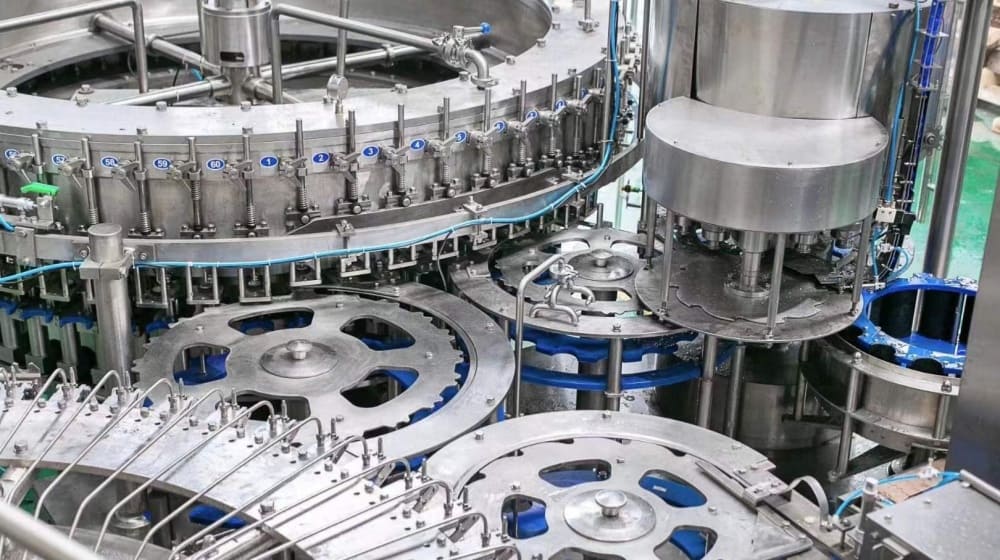
Key Components of a Filling Machine Production Line
A complete liquid filling production line normally consists of several interconnected machines.
1. Bottle Unscrambler
The bottle unscrambler automatically organizes empty bottles and feeds them into the production line in the correct direction and sequence.
This helps maintain a continuous bottle supply for high-speed filling operations.
2. Bottle Rinsing Machine
Before filling, containers may need to be cleaned or rinsed to remove dust and other contaminants.
Depending on the product and container type, different rinsing methods can be used, including water rinsing, sterile-water rinsing, air rinsing, or other specialized configurations.
3. Liquid Filling Machine
The liquid filling machine is the core equipment of the production line. It accurately transfers the required amount of product into each container.
Different filling technologies can be selected according to product characteristics, including:
- Gravity filling
- Volumetric filling
- Isobaric filling
- Piston filling
- Overflow filling
- Weight-based filling
Water, juice, carbonated beverages, sauces, oils, dairy products, and other liquids may require different filling solutions.
4. Capping Machine
After filling, the containers are sealed by an automatic capping machine.
Depending on the container and closure design, the system may use screw capping, press-on capping, or other sealing technologies.
A properly configured capping system helps prevent leakage and protects the product during storage and transportation.
5. Labeling Machine
The labeling machine automatically applies product labels to bottles or other containers.
Common solutions include pressure-sensitive labeling, wrap-around labeling, and shrink-sleeve labeling.
Labels can provide product information, branding, ingredients, and other required information.
6. Coding and Marking Machine
Coding equipment prints production-related information onto the package.
Typical information includes:
- Production date
- Expiration date
- Batch number
- Lot number
- Traceability codes
This equipment supports product traceability and production management.
7. Inspection and Checking System
Inspection equipment helps identify products that do not meet predefined quality requirements.
Depending on the application, inspection systems may check:
- Filling level
- Cap presence
- Cap position
- Bottle condition
- Label position
- Product leakage
- Code readability
Vision inspection and other automatic checking technologies can be integrated into high-speed production lines.
8. Packing Machine
At the end of the line, packing equipment groups finished products for transportation and distribution.
Depending on the packaging requirements, products can be packed into cartons, shrink-wrapped packs, trays, or other secondary packaging formats.
[Image Placeholder: Automatic bottle labeling, packing, and palletizing system]
Factors to Consider When Designing a Filling Production Line
A successful filling machine production line design should start with the product and packaging requirements.
Product Type and Viscosity
Different liquids require different filling technologies.
Low-viscosity products such as water may use high-speed filling systems, while thicker products such as sauces, honey, or creams may require piston or other positive-displacement filling technologies.
Carbonated beverages also require specialized pressure-controlled filling systems.
Production Capacity
The target output determines the required line speed and machine configuration.
For example, a small production facility may require a compact filling line, while a large beverage factory may need a fully automatic high-speed system.
Container Type and Size
The filling line should match the container material, shape, neck size, and volume.
PET bottles, glass bottles, cans, jars, and other containers may require different handling, filling, and sealing equipment.
Level of Automation
Production lines can range from semi-automatic systems to fully automated solutions.
A fully automatic filling line can connect bottle handling, rinsing, filling, capping, labeling, coding, inspection, and packing with limited operator intervention.
Factory Layout and Budget
The available factory space, utility conditions, equipment investment, and future expansion plans should also be considered during the design stage.
A well-planned line should provide an appropriate balance between production capacity, automation, investment, and future scalability.
Applications of Filling Machine Production Lines
Filling production lines are widely used in many industries.
Beverage Industry
Applications include:
- Bottled water
- Juice
- Tea
- Carbonated soft drinks
- Sparkling water
- Beer
- Dairy beverages
Food Industry
Filling systems can be used for:
- Sauces
- Syrups
- Edible oils
- Condiments
- Liquid food products
Chemical Industry
Depending on material compatibility, filling lines can handle products such as:
- Detergents
- Disinfectants
- Cleaning solutions
- Other liquid chemical products
Pharmaceutical and Personal Care
Specialized filling systems may also be used for liquid medicines, syrups, cosmetics, and personal care products, subject to the required hygiene and regulatory standards.
[Image Placeholder: Different liquid filling production line applications]
Benefits of an Automatic Filling Line
Higher Production Efficiency
Automation reduces repetitive manual operations and allows continuous production at a controlled speed.
Consistent Filling Quality
Automatic filling equipment provides more consistent dosing and helps reduce variations caused by manual filling.
Lower Labor Requirements
Automated bottle handling, filling, capping, labeling, and packing can reduce the amount of manual intervention required.
Better Hygiene
Reducing direct human contact with the product can support cleaner production conditions, particularly in beverage and food applications.
Flexible Production
A properly designed line can accommodate different container sizes or products when suitable changeover systems are included.
Easier Future Expansion
A modular automatic filling line can be designed with future capacity increases in mind, allowing manufacturers to expand production as market demand grows.
How to Choose a Filling Machine Manufacturer
When selecting a filling machine manufacturer, buyers should evaluate more than individual machine specifications.
Important factors include:
- Experience with similar products
- Filling technology
- Production capacity
- Container specifications
- Automation level
- Complete line integration
- Factory layout support
- Installation and commissioning
- Operator training
- After-sales service
- Spare parts support
For large beverage projects, choosing a supplier capable of providing a complete filling and packaging solution can simplify equipment coordination and project management.
Conclusion
A modern filling machine production line combines multiple machines into one coordinated production system. From bottle unscrambling and rinsing to filling, capping, labeling, coding, inspection, and packing, each stage contributes to the efficiency and quality of the finished product.
The right system should be designed according to the product characteristics, container type, production capacity, factory conditions, automation requirements, and future development plans.
For beverage and liquid product manufacturers, a well-designed automatic filling line can provide a practical foundation for stable, efficient, and scalable production.
FAQ
What is a filling machine production line?
It is an integrated system that connects equipment such as bottle handling, rinsing, filling, capping, labeling, inspection, and packing to automate liquid product packaging.
What machines are included in a filling line?
A typical line may include a bottle unscrambler, rinsing machine, filling machine, capping machine, labeling machine, coding system, inspection equipment, and packing machine.
How do I choose the right liquid filling machine?
The main factors include product viscosity, carbonation, filling volume, required accuracy, container type, production capacity, and automation level.
Can one filling line handle different bottle sizes?
Yes, some production lines can handle multiple bottle sizes through adjustable or interchangeable components. The actual range depends on the machine design and product requirements.
What industries use filling production lines?
Filling lines are widely used in beverage, food, chemical, pharmaceutical, cosmetics, and personal care industries.
What is the difference between a filling machine and a filling production line?
A filling machine performs the filling operation, while a complete filling production line connects filling with other processes such as bottle handling, rinsing, capping, labeling, inspection, and packing.