
Efficient honey production requires careful control of heating, concentration, filtration, storage, filling, sealing, capping, and labeling. For small and medium-scale honey producers, the production line should maintain stable product quality while providing accurate filling and reliable packaging performance.
This project is designed for a honey production and filling application with a planned daily production capacity of approximately 500 kg. The filling format is a 28 g PET bottle, with a target production speed of approximately 1,800 bottles per hour.
The production process includes honey heating, vacuum concentration, filtration, storage, servo filling, induction foil sealing, screw capping, labeling, and conveying.
Project Requirements
The main customer requirements can be summarized as follows:
| Project Item | Confirmed Requirement |
|---|---|
| Daily Production | Approximately 500 kg/day |
| Bottle Size | 28 g |
| Filling Capacity | Approximately 1,800 bottles/hour |
| Bottle Material | PET |
| Cap Material | Tinplate |
| Cap Diameter | 44.7 mm |
| Cap Height | 33 mm |
| Filling Temperature | Approximately 45°C |
| Raw Material Moisture | Approximately 23% |
| Finished Honey Moisture | Approximately 18% |
| Heating | Required for the feed hopper |
| Concentration Filtration | 25–45 μm requirement |
| Electrical Supply | Equipment-specific, including 380 V equipment |
These requirements provide the basic reference for selecting the heating, concentration, filtration, storage, filling, and packaging equipment.
Honey Processing and Filling Flow
The proposed process is designed around the customer’s required production and packaging format.
A simplified process flow is:
Honey Feeding → Heating → Vacuum Concentration → Filtration → Storage → Servo Filling → Induction Foil Sealing → Screw Capping → Labeling → Conveying
Each stage performs a specific function within the production process.
Heating helps maintain suitable honey viscosity for subsequent processing and filling. Vacuum concentration is used to reduce moisture from the incoming honey, while filtration helps remove unwanted particles before the product enters the storage and filling stages.
After filtration, the processed honey is transferred to a heated storage and filling system. The honey is then filled into 28 g PET bottles, followed by foil sealing, capping, labeling, and conveying.
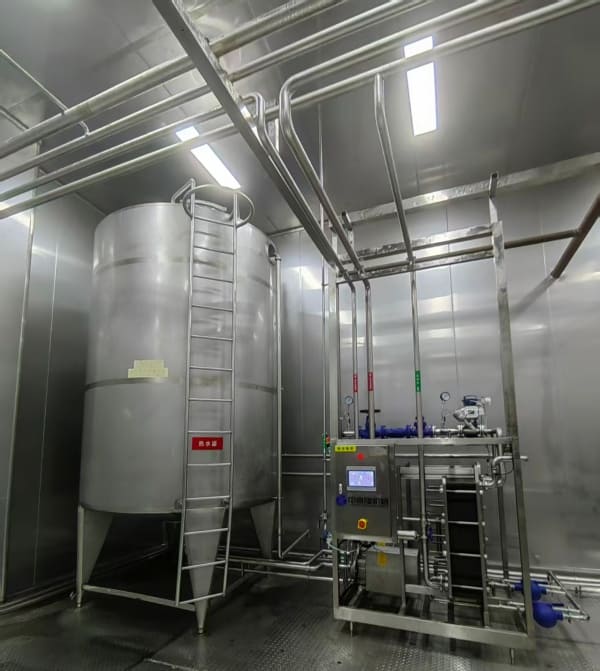
Honey Heating System
Honey viscosity can affect pumping and filling performance, particularly when the product needs to be transferred through pipelines and filling valves.
The project therefore includes a 300 L heating tank.
According to the supplied equipment requirements, the heating tank uses water-bath heating and has a temperature range of 0–100°C.
| Parameter | Specification |
|---|---|
| Tank Volume | 300 L |
| Single Processing Volume | 50 L |
| Material | Stainless steel |
| Heating Method | Water-bath heating |
| Heating Range | 0–100°C |
| Power Supply | 380 V / 18 kW |
| Dimensions | 1.3 × 1.05 × 0.71 m |
| Net Weight | 60 kg |
The system also requires heating for the feed hopper to help maintain appropriate honey flow during production.
Vacuum Honey Concentration
The customer’s raw honey has an initial moisture content of approximately 23%, while the finished product is required to reach approximately 18% moisture.
The vacuum concentration stage is therefore an important part of the process.
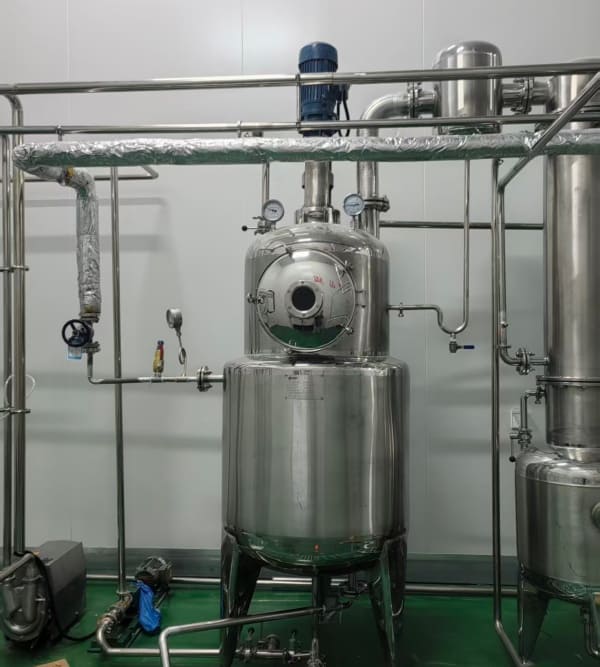
The supplied specification includes a 50 L vacuum concentrator, with a 50 L preheating tank and an 80 L concentration tank.
The equipment uses water-bath heating and vacuum operation.
| Parameter | Specification |
|---|---|
| Preheating Tank | 50 L |
| Concentration Tank | 80 L |
| Product-Contact Material | 304 Stainless Steel |
| Inner Wall Thickness | 3 mm |
| Outer Wall Thickness | 3 mm |
| Heating Method | Water-bath heating |
| Preheating Power | 220 V / 6 kW + 0.55 kW mixing |
| Concentration Heating | 220 V / 6 kW |
| Vacuum Pump | 1.5 kW |
| Filtration Specification | 120–200 mesh |
| Water Consumption | 3 t/h |
| Supply Water Temperature | ≤30°C |
| Working Pressure | ≥0.08 MPa |
The final operating conditions should be confirmed according to the actual honey characteristics and required moisture level.
Honey Filtration System
Filtration is included after the concentration process to improve product cleanliness before the honey enters the storage and filling stages.
The project specifies a filtration requirement of 25–45 μm for the concentration and filtration process, while the supplied filter specification also lists a 120–200 mesh filtration unit.
The proposed filter has a 30 L filter tank and a nominal capacity of 1 t/h.
| Parameter | Specification |
|---|---|
| Filter Capacity | 1 t/h |
| Filter Tank Volume | 30 L |
| Filter Precision | 120–200 mesh |
| Tank Height | 50 cm |
| Total Height | 80 cm |
| Connection | 50.5 mm sanitary clamp |
| Filter Pressure | ≤8 MPa |
Because filtration requirements can vary according to the honey source and processing conditions, the final filtration configuration should be confirmed before equipment manufacturing.
Honey Transfer and Pumping
The production line includes several 1 t/h concentrated honey pumps for transferring product between the heating, concentration, filtration, storage, and filling stages.
The supplied pump specification is:
- Capacity: 1 t/h
- Material: SUS304 stainless steel
- Motor power: 1.5 kW
- Voltage: 380 V
- Frequency: 50/60 Hz
- Dimensions: 1200 × 370 × 420 mm
The pump configuration should be arranged according to the final process flow and the actual distance between equipment.
Honey Storage Tank with Heating
After concentration and filtration, the honey needs to be held in a storage tank before filling.
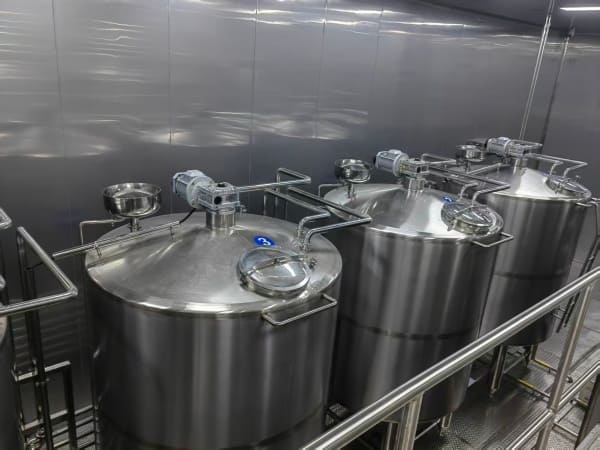
The project includes a 300 L stainless steel storage tank.
The tank is equipped with a manhole, breather, level indicator, thermometer, and bottom-cone agitator.
| Parameter | Specification |
|---|---|
| Tank Volume | 300 L |
| Material | 304 Stainless Steel |
| Power | 380 V / 0.75 kW |
| Tank Dimensions | Ø600 × 1100 mm |
| Wall Thickness | 3 mm |
| Configuration | Manhole, breather, level gauge, thermometer |
| Mixing | Bottom-cone agitation |
The filling storage system is also specified with a heating system to help maintain suitable honey flow during filling.
8-Head Servo Honey Filling Machine
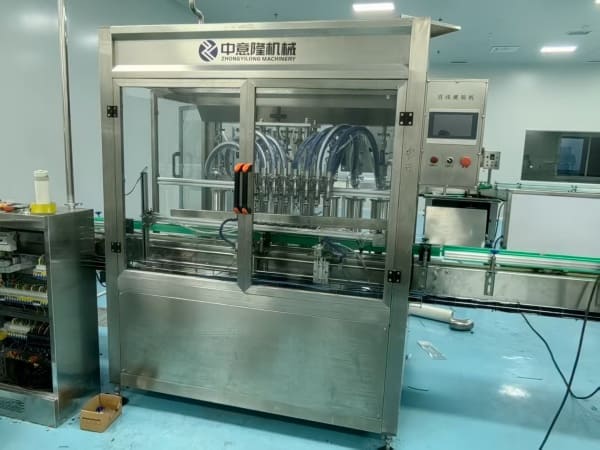
The core packaging equipment is an 8-head servo filling machine.
The supplied equipment specification lists a target capacity of 2,000 bottles per hour, while the overall project production requirement is approximately 1,800 bottles per hour for 28 g bottles.
This provides a suitable reference for the planned production speed.
The servo filling system is connected to the heated storage tank so that honey can be maintained at the required filling condition.
The project specifies a filling temperature of approximately 45°C.
Induction Foil Sealing and Capping
After filling, the PET bottles pass through an automatic electromagnetic induction foil sealing machine.
The supplied project equipment includes a ZYL-1800 automatic electromagnetic induction aluminum foil sealing machine.
Foil sealing provides an additional sealed layer before the bottle is capped.
The line then uses an automatic four-head screw capping machine.
The specified tinplate cap has:
- Diameter: 44.7 mm
- Height: 33 mm
The bottle and cap specifications should be checked together during the final packaging equipment configuration to ensure proper sealing and capping performance.
Automatic Honey Bottle Labeling
After sealing and capping, the bottles are transferred to a single-side labeling machine.
The labeling system is designed for the PET honey bottles used in the project.
A conveyor system connects the filling, sealing, capping, and labeling equipment, allowing the bottles to move continuously through the packaging process.
Complete Equipment Configuration
The main equipment included in the supplied project configuration is:
| Equipment | Specification | Quantity |
|---|---|---|
| Heating Tank | 300 L | 1 |
| Concentrated Honey Pump | 1 t/h | 3 |
| Vacuum Concentrator | 50 L / 80 L | 1 |
| Filter | 1 t/h | 1 |
| Storage Tank | 300 L | 1 |
| Servo Filling Machine | 8 Heads / 2,000 BPH | 1 |
| Induction Foil Sealing Machine | ZYL-1800 | 1 |
| Automatic Screw Capping Machine | 4 Heads | 1 |
| Single-Side Labeling Machine | Automatic | 1 |
| Conveyor | Production line conveyor | 1 |
This configuration provides the basic equipment chain from honey preparation and concentration to final bottle packaging.
Confirmed Data Versus Target Data
For a customized honey production project, it is important to distinguish confirmed customer requirements from equipment performance targets.
Confirmed Data
The customer has specified:
- Approximately 500 kg/day production
- 28 g PET bottles
- Approximately 1,800 bottles/hour
- 45°C filling temperature
- Initial moisture approximately 23%
- Finished honey moisture approximately 18%
- 44.7 mm × 33 mm tinplate cap
- Heated feed hopper
- Honey heating, concentration, filtration, storage, filling, sealing, capping, and labeling
Target or Equipment Reference Data
Some values in the equipment specification are equipment parameters rather than guaranteed final production performance. These include:
- 2,000 BPH filling machine capacity
- 1 t/h pump capacity
- 120–200 mesh filter specification
- Vacuum concentrator working parameters
- Heating power
- Water consumption
- Individual equipment dimensions
Actual production performance should be evaluated according to honey viscosity, temperature, moisture content, bottle format, product characteristics, and operating conditions.
Why a Complete Honey Production Line Matters
A complete production line helps connect the individual processing stages into one controlled workflow.
For this project, the key considerations are:
Controlled Heating + Moisture Reduction + Filtration + Stable Storage + Accurate Filling + Reliable Sealing + Efficient Packaging
The heating system supports product transfer and filling. Vacuum concentration addresses the moisture reduction requirement. Filtration prepares the honey for downstream packaging, while the heated storage tank supports stable filling conditions.
The packaging section then completes filling, foil sealing, capping, labeling, and conveying.
Conclusion
This honey production project is designed for approximately 500 kg of honey per day, with a packaging format of 28 g PET bottles and a target filling speed of approximately 1,800 bottles per hour.
The production process combines heating, vacuum concentration, filtration, storage, servo filling, induction foil sealing, screw capping, labeling, and conveying.
The customer’s key product requirement is to reduce honey moisture from approximately 23% to 18%, while maintaining a filling temperature of approximately 45°C.
The final equipment configuration should be confirmed according to the customer’s actual honey characteristics, production schedule, bottle and cap dimensions, and required product quality.
For honey producers looking to improve processing and packaging efficiency, a customized line can integrate honey preparation and concentration with automatic filling and packaging equipment.
FAQ
1. What is the production capacity of this honey line?
The project is designed for approximately 500 kg of honey per day.
2. What bottle size is used?
The specified bottle is a 28 g PET bottle.
3. What is the target filling speed?
The customer requires approximately 1,800 bottles per hour. The selected 8-head servo filling machine is specified at 2,000 BPH.
4. What is the honey filling temperature?
The required filling temperature is approximately 45°C.
5. What moisture reduction is required?
The raw honey moisture is approximately 23%, and the finished honey is required to reach approximately 18%.
6. Does the honey line include concentration equipment?
Yes. The supplied configuration includes a vacuum concentrator with a 50 L preheating tank and an 80 L concentration tank.
7. Does the line include filtration?
Yes. The project includes a 1 t/h filtration unit. The customer requirement also specifies a filtration range of 25–45 μm, which should be confirmed against the final filtration configuration.
8. What type of bottle cap is used?
The project specifies a tinplate cap with a diameter of 44.7 mm and a height of 33 mm.
9. Does the line include automatic packaging equipment?
Yes. The configuration includes servo filling, electromagnetic induction foil sealing, four-head screw capping, single-side labeling, and conveyors.
10. Can the honey production line be customized?
Yes. Heating, concentration, filtration, storage, filling capacity, bottle size, capping, labeling, and conveying can be configured according to the actual production requirements.
Request a Customized Honey Production Solution
If you are planning a honey processing and filling project, send us your daily production capacity, bottle size, honey moisture, filling temperature, packaging type, and factory requirements.
Our engineering team can evaluate your requirements and provide a customized honey production and filling solution, including equipment configuration, process flow, layout, and quotation.