
Liquid fertilizer production involves several interconnected stages, including raw material preparation, dissolving, reaction or fermentation, blending, filtration, filling, and final packaging.
Different fertilizer formulations require different processing equipment. For example, a production line for water-soluble NPK fertilizer may focus on efficient dissolving and blending, while amino acid liquid fertilizer, fish protein fertilizer, and organic liquid fertilizer may require additional reaction, fermentation, filtration, or temperature-control systems.
Selecting equipment according to the actual product characteristics is important for achieving stable production and consistent product quality.
1. Main Equipment for a Liquid Fertilizer Production Line
A complete liquid fertilizer production line can be configured with several processing and packaging systems.
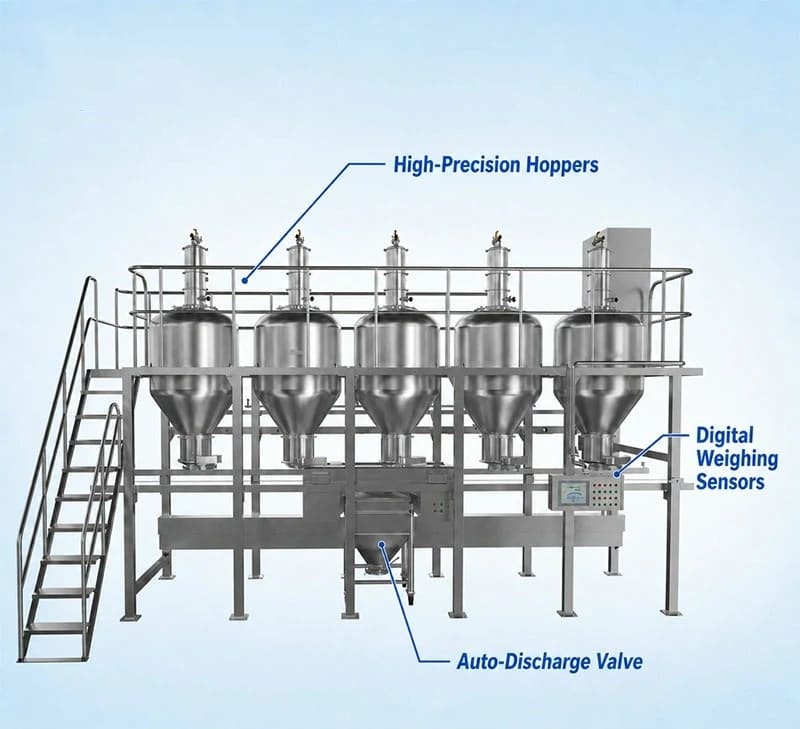
Raw Material Pretreatment and Dissolving System
The first stage is usually the preparation and dissolution of raw materials.
A raw material feeding and dissolving system may include:
- Dust-controlled feeding equipment
- Dissolving tanks
- Agitators
- Heating systems
- Transfer pumps
- Liquid-level monitoring
These systems help dissolve materials such as humic acid, amino acids, and water-soluble fertilizer ingredients efficiently and reduce the risk of undissolved particles, clumping, or sedimentation.
Reaction and Fermentation System
The required equipment depends on the fertilizer formulation.
For organic liquid fertilizer or biological fertilizer, fermentation tanks may be equipped with agitation, temperature control, and aeration systems.
For conventional water-soluble fertilizer, the process may use blending or reaction tanks with high-shear mixing or emulsification functions. These systems help achieve uniform mixing and stable formulation.
The exact tank configuration should be selected according to the raw materials and production process.
Filtration and Purification System
After mixing or reaction, the liquid fertilizer may need to pass through a filtration system.
Precision filters or, for suitable applications, centrifuges can be used to remove impurities and undissolved particles.
Effective filtration can help:
- Improve liquid clarity
- Reduce suspended particles
- Improve product stability
- Protect filling nozzles and downstream equipment
- Reduce the risk of blockage during filling
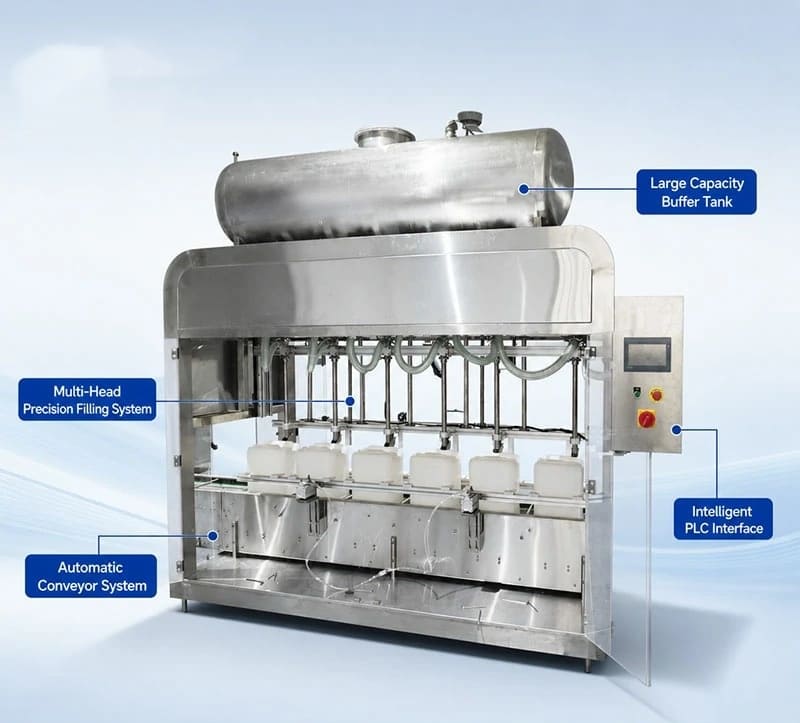
Liquid Fertilizer Filling System
The liquid fertilizer filling machine should be selected according to the packaging format and product characteristics.
For small bottles, piston or servo-controlled filling systems may be suitable for products with appropriate flow characteristics.
For larger containers such as 20L, 200L drums, or IBC tanks, weighing filling systems can be considered when mass-based filling accuracy is required.
The final filling technology should be determined according to viscosity, density, filling volume, container design, and required production capacity.
Downstream Packaging System
After filling, the product can enter an automated packaging section.
Typical equipment includes:
- Automatic capping machines
- Aluminum foil sealing machines
- Labeling machines
- Inkjet or laser coding machines
- Conveyors
- Cartoning or packing equipment
This allows the process to move from filling to finished-product packaging with reduced manual handling.
Central Control System
A PLC-based control system can coordinate different stages of the production process.
Depending on the project requirements, the system can monitor and control parameters such as:
- Temperature
- pH value
- Tank level
- Mixing time
- Pump operation
- Formulation ratios
A centralized PLC and HMI system can also make it easier for operators to manage different production recipes and monitor equipment status.
2. Key Factors When Selecting Liquid Fertilizer Equipment
Selecting the right liquid fertilizer production equipment requires more than simply choosing a machine based on capacity.
Understand the Product Characteristics
Before purchasing equipment, determine the basic properties of the fertilizer, including:
- Viscosity
- Density
- Temperature
- Corrosiveness
- Solid particle content
- Foaming characteristics
High-viscosity products may require suitable positive-displacement pumps or other specialized transfer and filling systems.
Products with good flow characteristics may be compatible with flow-based filling technologies.
Select the Correct Material
Material compatibility is particularly important for fertilizer production.
For many conventional fertilizer applications, 304 stainless steel may be suitable.
However, if the formulation contains corrosive acidic, alkaline, or other aggressive components, product-contact parts may require upgraded materials such as:
- 316L stainless steel
- PP
- PVDF
- Other chemically compatible materials
The final material selection should be based on the actual chemical composition and operating conditions.
Choosing unsuitable materials can result in corrosion, leakage, contamination, and increased maintenance costs.
Match Filling Accuracy With Production Capacity
It is not always necessary to select the highest-speed filling machine.
For small-batch production with frequent formulation or bottle changes, a flexible modular system with fast changeover can be more practical.
For large-volume production, a fully automatic packaging line can integrate:
Bottle Feeding → Filling → Capping → Sealing → Labeling → Coding → Packing
The machine configuration should balance filling accuracy, production capacity, flexibility, and investment cost.
Consider Safety and Cleaning
Chemical fertilizer products may require additional safety measures depending on their composition and operating environment.
For certain applications, equipment may need suitable electrical protection, enclosed filling areas, and leak-control measures.
A CIP (Clean-in-Place) system can also be considered for production lines that frequently change between different formulations. It can simplify internal cleaning of tanks, pipes, pumps, and filling systems and help reduce cross-contamination between batches.
3. Standard Liquid Fertilizer Production Process
Although the exact process varies according to the fertilizer formulation, a typical liquid fertilizer production process can include the following stages.
Step 1: Feeding and Dissolving
Raw materials are introduced into a dissolving tank through a controlled feeding system.
Agitation and, when required, heating help dissolve the materials and create a uniform solution.
Step 2: Reaction and Chelation
The dissolved solution is transferred to a reaction or blending tank.
Depending on the formulation, trace elements or functional ingredients can then be added.
High-shear mixing or emulsification may be used where appropriate to improve dispersion and help maintain a stable formulation.
Step 3: Filtration
The mixed fertilizer solution passes through a suitable filtration system to remove impurities and undissolved particles.
This step helps improve product consistency and protects downstream filling equipment.
Step 4: Quantitative Filling
The finished liquid fertilizer is transferred to the filling machine.
The machine accurately fills the product into the required packaging, such as plastic bottles, jerrycans, drums, or IBC containers.
Step 5: Capping, Labeling and Coding
After filling, the containers are automatically capped or sealed.
They can then pass through labeling and coding equipment before being packed and transferred to the finished-product storage area.
4. Liquid Fertilizer Production Line for Different Products
Different fertilizer products may require different equipment configurations.
Water-Soluble NPK Fertilizer
The production process generally focuses on accurate ingredient dosing, rapid dissolving, uniform blending, filtration, and filling.
Amino Acid Liquid Fertilizer
Amino acid formulations may require controlled mixing and suitable product-contact materials depending on the formulation and raw materials.
Fish Protein Fertilizer
Fish protein fertilizer may require specialized pretreatment, mixing, filtration, and odor-control considerations depending on the raw material and final formulation.
Organic Liquid Fertilizer
Organic liquid fertilizers may require fermentation tanks, temperature control, agitation, aeration, and additional filtration before filling.
Therefore, the equipment should be designed around the actual formulation rather than using the same configuration for every type of liquid fertilizer.
5. How to Choose a Liquid Fertilizer Production Line
Before requesting a quotation, it is useful to provide the equipment manufacturer with:
- Fertilizer type and formulation
- Raw material information
- Target production capacity
- Product viscosity and density
- Required tank volumes
- Filling volume
- Container sizes
- Required filling accuracy
- Factory location
- Available power supply
- Automation requirements
For example, a project producing 500ml, 1L, 5L, 20L, or larger containers may require different filling and packaging configurations.
Providing this information allows the supplier to design a more suitable liquid fertilizer production line instead of selecting equipment based only on nominal capacity.
Conclusion
A complete liquid fertilizer production line combines processing and packaging equipment to create a continuous production workflow.
The typical process includes:
Raw Material Feeding → Dissolving → Reaction/Blending → Fermentation if Required → Filtration → Filling → Capping → Labeling → Coding → Packaging
The most suitable configuration depends on the fertilizer formulation, viscosity, corrosiveness, production capacity, packaging size, and automation requirements.
For this reason, the liquid fertilizer production line should be designed as an integrated system rather than selecting individual machines separately.
FAQ
What equipment is needed for a liquid fertilizer production line?
A typical line may include dissolving tanks, mixing or reaction tanks, fermentation tanks when required, filtration equipment, transfer pumps, filling machines, capping machines, labeling machines, coding equipment, conveyors, and a PLC control system.
What is the production process for liquid fertilizer?
A typical process includes raw material feeding, dissolving, reaction or blending, fermentation when required, filtration, quantitative filling, capping, labeling, coding, and packaging.
What filling machine is suitable for liquid fertilizer?
The appropriate liquid fertilizer filling machine depends on viscosity, density, filling volume, container size, and production capacity. Piston, pump, flow-based, or weighing filling systems may be considered for different applications.
Is 304 stainless steel suitable for liquid fertilizer equipment?
304 stainless steel can be suitable for many conventional applications. However, corrosive formulations may require 316L stainless steel, PP, PVDF, or other compatible materials for product-contact components.
Can the liquid fertilizer production line be fully automated?
Yes. A complete automated system can integrate material feeding, mixing, filtration, filling, capping, labeling, coding, and conveying under PLC and HMI control.
Can one production line produce different liquid fertilizers?
In many cases, equipment can be designed for multiple formulations. However, compatibility between products, cleaning requirements, material selection, and cross-contamination risks must be evaluated before finalizing the system.
Get a Customized Liquid Fertilizer Production Solution
Planning a liquid fertilizer production line for water-soluble fertilizer, amino acid fertilizer, fish protein fertilizer, or organic liquid fertilizer?
Zhongyilong can develop a customized solution based on your formulation, production capacity, packaging size, product characteristics, and factory conditions.
Send us your fertilizer type, target capacity, packaging sizes, and factory location to discuss the required processing and filling equipment.
WhatsApp: +86 191 3817 1383
Email: zhongyilong@zylpacking.com