
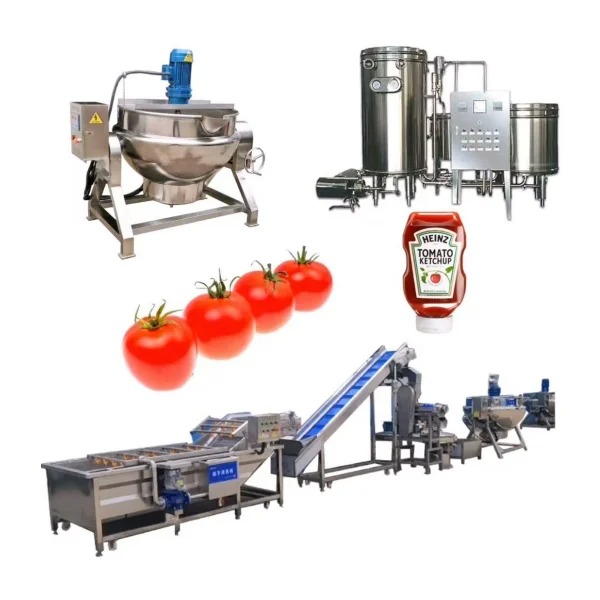
Tomato paste production requires controlled processing from fresh tomato preparation through concentration and final packaging. For this Argentina project, the customer required a compact tomato paste production line with a target output of 200 kg/h and 250 g plastic bottle packaging.
The project was delivered as a turnkey tomato paste production line, integrating the main processing and packaging stages into one production system.
The line was designed around approximately 10 main equipment units, together with auxiliary transfer pumps, filtration, piping, and CIP cleaning systems.
Project Overview
| Item | Specification |
|---|---|
| Product | Tomato Paste |
| Production Capacity | 200 kg/h |
| Package | 250 g plastic bottle |
| Project Location | Argentina |
| Project Type | Turnkey production line |
| Main Processing | Washing, pulping, concentration, blending, filling and pasteurization |
| Cleaning | CIP cleaning system |
At a nominal 200 kg/h product output, a 250 g package corresponds to approximately 800 bottles per hour if calculated purely from product weight. Actual packaging output depends on filling speed, product losses, operating conditions, and the final machine configuration.
1. Tomato Raw Material Pretreatment
The first stage of the tomato paste production process is raw material cleaning and preparation.
Bubble Washing and Lifting Machine
The production line uses a 0.5 t/h bubble washing and lifting machine made from SUS304 stainless steel.
The machine uses an air-bubble system to create a rolling water flow that helps remove dirt and impurities from the tomato surface.
The integrated lifting system transfers the cleaned tomatoes to the next processing stage.
Main features include:
- SUS304 stainless steel construction
- 380 V power supply
- 2.2 kW bubble motor
- Customized outlet height
- Integrated washing and lifting
2. Tomato Pulping
After washing, the tomatoes enter a double-stage pulping machine.
The pulper is designed for tomato processing and has a stated production capacity of approximately 1 t/h, providing sufficient processing capacity for the project’s 200 kg/h finished-product target.
The machine is made from SUS304 stainless steel and uses two processing stages.
The first stage uses a 5.5 kW motor, while the second stage uses a 4 kW motor.
The double-stage design helps separate tomato pulp from unwanted solid material before concentration.
Image Placeholder: Tomato pulping machine
Suggested Alt Text: Double-stage tomato pulping machine for tomato paste production
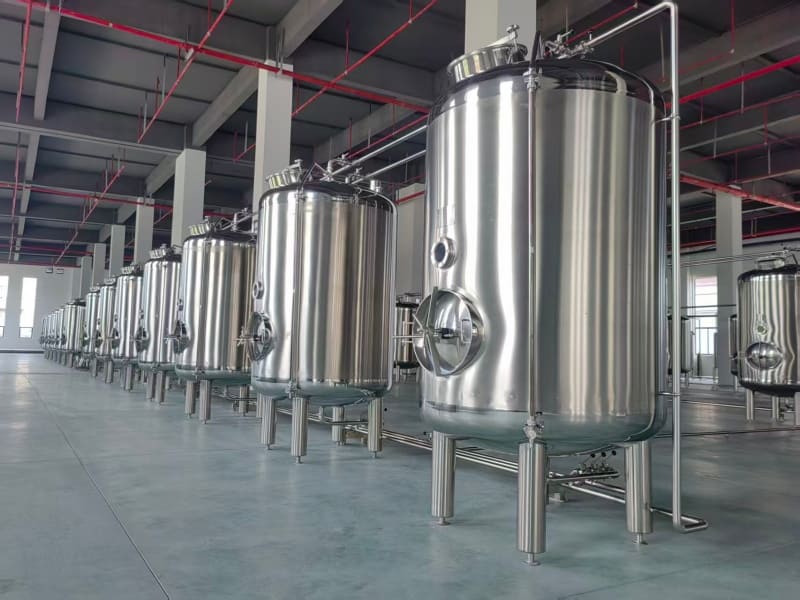
3. Tomato Paste Storage
A 500 L SUS304 stainless steel storage tank is included after the initial processing stage.
The tank features:
- Single-layer construction
- Conical top and bottom
- Level indicator
- Manhole
- Breathing device
- CIP cleaning port
- Ø38 sanitary quick connection
The storage tank provides temporary buffering between upstream tomato processing and the concentration system.
4. Tomato Paste Concentration and Blending
Concentration is one of the key stages in tomato paste processing.
Single-Effect Concentrator
The project includes a 500 L single-effect concentration unit.
The equipment specification includes:
- Capacity: 500 L
- Evaporation capacity: 500 kg/h
- Steam consumption: 285 kg/h
- Heating area: 13.5 m²
- Condensation area: 11 m²
- Steam pressure: 0.03–0.09 MPa
- Approximate dimensions: 4000 × 1500 × 3300 mm
The concentration stage removes water from the tomato product to achieve the required paste consistency.
Jacketed Mixing Kettle
A 300 L jacketed kettle is used for heating and mixing.
The kettle is made from SUS304 stainless steel and uses steam heating.
It is equipped with an agitator and wall-scraping system to improve mixing and reduce material accumulation on the tank wall.
The agitator motor power is 1.5 kW.
Transfer and Filtration
SUS304 stainless steel screw pumps are used to transfer the tomato product between processing stages.
A stainless steel pipeline filter is also included to help remove unwanted particles before the product reaches the filling system.
5. 250 g Tomato Paste Filling and Packaging
After processing and blending, the finished tomato paste is transferred to the filling section.
Tomato Paste Filling Machine
The project includes a tomato paste filling machine designed for 250 g plastic bottle packaging.
The filling system provides quantitative filling of the finished product into the customer’s selected plastic containers.
For viscous products such as tomato paste, the filling machine should be configured according to the actual product viscosity, temperature, particle content, and filling volume.
Capping Machine
After filling, the containers are transferred to the automatic capping machine.
The capping stage helps close the bottles before the post-filling pasteurization process.
6. Pasteurization System
A SUS304 stainless steel pasteurization tank is installed after filling.
The equipment is designed for post-filling pasteurization and uses electric heating with automatic temperature control.
The approximate equipment dimensions are 1080 × 1080 × 850 mm.
Pasteurization parameters should be determined according to the tomato paste formulation, packaging material, filling temperature, and validated process requirements.
7. CIP Cleaning System
The turnkey project also includes a CIP cleaning system.
Clean-in-Place technology allows product-contact tanks, pipelines, pumps, and other suitable equipment to be cleaned without extensive disassembly.
This is particularly useful for food-processing lines where regular cleaning is required between production batches.
The final CIP configuration can be designed according to the equipment layout and cleaning requirements of the tomato paste production process.
8. Main Equipment Configuration
The project is designed around approximately 10 main equipment units, supported by transfer, filtration, piping, and cleaning systems.
The main equipment includes:
- Bubble washing and lifting machine
- Double-stage pulping machine
- 500 L storage tank
- 500 L concentration unit
- 300 L jacketed kettle
- Tomato paste filling machine
- Automatic capping machine
- Pasteurization tank
- Product transfer system
- Main process support and control system
Additional auxiliary equipment includes screw pumps, pipeline filtration, sanitary piping, and the CIP cleaning system.
The exact final equipment configuration should be confirmed according to the customer’s tomato variety, formulation, bottle specifications, filling temperature, and production requirements.
9. Complete Tomato Paste Production Process
The general process for this project can be summarized as:
Tomato Receiving → Bubble Washing → Lifting → Pulping → Storage → Concentration → Blending/Heating → Filtration → Filling → Capping → Pasteurization → Finished Product
This integrated workflow helps connect raw material preparation with final packaging and provides a practical solution for small- to medium-scale tomato paste production.
Conclusion
This Argentina project demonstrates a compact 200 kg/h tomato paste production line designed for 250 g plastic bottle packaging.
The turnkey system combines tomato washing, pulping, storage, concentration, blending, filtration, filling, capping, pasteurization, and CIP cleaning.
For tomato paste manufacturers, the final equipment configuration should be based on the required production capacity, tomato characteristics, paste viscosity, packaging format, filling volume, and factory conditions.
FAQ
What is the capacity of this tomato paste production line?
The target finished-product capacity for this Argentina project is 200 kg/h.
What package size is used for the tomato paste?
The project is designed for 250 g plastic bottles.
What is the approximate bottle output at 200 kg/h?
If each bottle contains 250 g, 200 kg/h corresponds theoretically to approximately 800 bottles per hour. Actual output depends on the filling machine and production conditions.
What equipment is included in the tomato paste production line?
The main equipment includes a bubble washing and lifting machine, double-stage pulper, storage tank, concentration unit, jacketed kettle, filling machine, capping machine, pasteurization tank, and supporting transfer and control systems.
Does the line include CIP cleaning?
Yes. The project includes a CIP cleaning system for cleaning suitable product-contact equipment and pipelines.
Can the tomato paste production line use different bottle sizes?
The filling system can potentially be configured for different filling volumes, but the final bottle range and changeover requirements should be confirmed before equipment selection.
Can Zhongyilong provide a turnkey tomato paste production line?
Yes. A tomato paste project can be configured as a turnkey solution covering processing equipment, filling and packaging equipment, auxiliary systems, installation, commissioning, and technical support.
Discuss Your Tomato Paste Production Project
If you are planning a tomato paste production line, Zhongyilong can develop a customized solution according to your target capacity, tomato raw materials, paste formulation, bottle size, filling volume, and factory conditions.
For a project proposal, please provide your required capacity, package size, bottle type, tomato product specifications, and factory location.
WhatsApp: +86 191 3817 1383
Email: zhongyilong@zylpacking.com