
A liquid fertilizer manufacturer in the Netherlands planned a complete production and packaging system for several bottle sizes, including 500ml, 1L, 5L and 20L.
The 1L bottle is the main packaging format, with a target filling capacity of approximately 2,000 bottles per hour. The project also requires 5L and 20L packaging formats for larger-volume fertilizer products, while 500ml is intended as an additional bottle size.
To make the production system more integrated, the customer also requires PET bottle blowing equipment and bottle cap manufacturing equipment so that the packaging containers can be produced as part of the overall project.
The proposed solution covers the main production stages from fertilizer formulation and mixing to filling, capping, labeling, coding and final packaging.
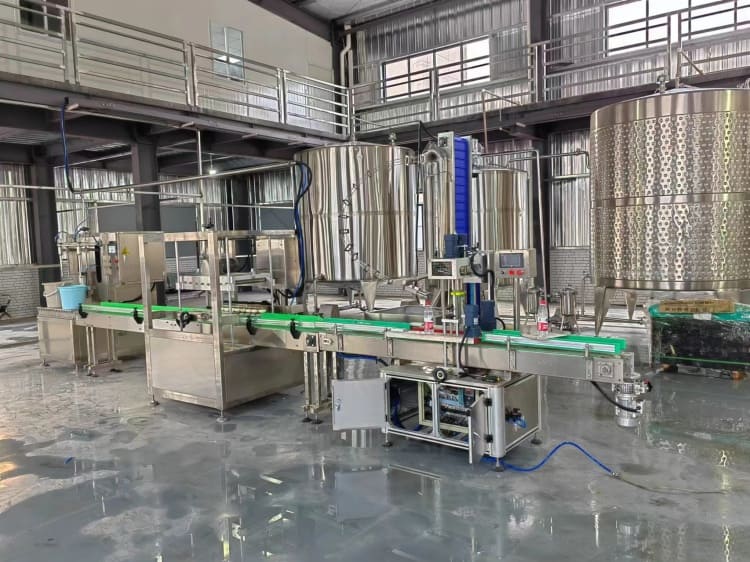
Netherlands Liquid Fertilizer Project Requirements
The production line is designed around four bottle sizes.
| Bottle Size | Target Filling Capacity | Production Role |
|---|---|---|
| 500ml | Flexible | Additional bottle size |
| 1L | 2,000 BPH | Main bottle size |
| 5L | 500–1,000 BPH | Medium-size packaging |
| 20L | 500 BPH | Large-volume packaging |
The customer also requires bottle blowing equipment with the following target capacities:
| Bottle Size | Required Blow Molding Capacity |
|---|---|
| 1L | 1,000 BPH |
| 5L | 300 BPH |
| 20L | 90 BPH |
This means that the project is not simply a conventional liquid fertilizer filling line. It is a multi-format fertilizer production and packaging project combining liquid processing, bottle production and packaging.
Complete Liquid Fertilizer Production Process
The proposed production process can be organized as:
Raw Material Preparation → Mixing → Emulsification → Filtration → Finished Product Storage → Filling → Capping → Foil Sealing → Labeling → Coding → Packaging
For customers who want to manufacture their own PET bottles, the upstream packaging process can additionally include:
PET Preform Heating → Bottle Blowing → Bottle Cooling → Bottle Collection → Filling Line
Bottle cap manufacturing can also be integrated into the packaging supply chain.
5m³ Liquid Fertilizer Mixing System
The project includes three 5m³ mixing tanks.
The tanks are made from SUS304 stainless steel and use a three-layer structure.
Each tank includes:
- Agitation system
- Electric heating system
- Insulation layer
- Product inlet and outlet
- CIP cleaning connection
- Upper and lower conical structure
- Four support legs
The heating power is 72 kW, using thermal oil heating.
The mixing system uses a 7.5 kW agitator.
Thermal oil is supplied by the customer.
The three-tank configuration provides additional flexibility for batch preparation and production scheduling. Depending on the fertilizer formulation, multiple tanks can also help separate preparation and transfer operations.
Emulsification and Filtration
After mixing, the liquid fertilizer can pass through an emulsification process when required by the formulation.
The proposed emulsification unit has:
| Parameter | Specification |
|---|---|
| Processing Capacity | 0–8 m³/h |
| Motor Power | 7.5 kW |
| Speed | 2,800 rpm |
The system also includes a duplex filter made of SUS304 stainless steel.
The filtration range is 50–200 mesh.
The filtration stage helps remove unwanted particles before the fertilizer enters the finished-product tank and filling system.
The exact filtration mesh should ultimately be selected according to the actual fertilizer formulation.
10m³ Finished Product Tank
After processing and filtration, the liquid fertilizer is transferred to a 10m³ finished-product tank.
The tank is made from SUS304 stainless steel and includes:
- Single-layer tank structure
- Agitation system
- 5.5 kW agitator
- Product inlet and outlet
- Breather
- CIP cleaning connection
- Manhole
- Liquid level indicator
The finished-product tank acts as a buffer between the fertilizer processing system and the filling line.
This is useful when the upstream batch production rate and downstream filling rate are not exactly the same.
Liquid Fertilizer Filling System
The Netherlands project requires different filling capacities for different bottle sizes.
Therefore, the filling equipment should be selected according to both bottle volume and product characteristics.
1L Liquid Fertilizer Filling — 2,000 BPH
The proposed filling machine is a 12-head inline liquid filling machine.
Its stated specifications are:
| Parameter | Specification |
|---|---|
| Filling Heads | 12 |
| Rated Speed | 3,000 BPH |
| Filling Range | 100–1,000ml |
| Filling Accuracy | ±1% |
| Bottle Diameter | Φ40–100mm |
| Bottle Height | 60–300mm |
| Air Pressure | 6–8 kg/cm² |
| Air Consumption | Approx. 1 m³/min |
| Total Power | 5 kW |
Technical Judgment
The target for the 1L bottle is 2,000 BPH.
The proposed machine has a stated maximum production speed of 3,000 BPH, so the nominal machine capacity is sufficient for the required 1L production output.
The filling range also covers 1L.
Therefore:
The 12-head inline filling machine is suitable for the 1L / 2,000 BPH requirement, provided that the actual liquid fertilizer viscosity and foaming characteristics are compatible with the filling system.
The final operating speed may be adjusted below the machine’s maximum rated capacity depending on the product.
Can the Same Filling Machine Be Used for 5L?
No.
The proposed 12-head inline filling machine has a filling range of:
100–1,000ml
Therefore, it cannot directly fill the customer’s 5L bottles.
A separate filling machine or a different filling configuration is required for 5L fertilizer.
The 5L filling system should be selected according to:
- 5L filling volume
- Fertilizer viscosity
- Bottle neck size
- Bottle dimensions
- Filling accuracy
- Target output of 500–1,000 BPH
Therefore, the final quotation should not treat the 1L and 5L filling systems as one identical filling machine.
20L Liquid Fertilizer Filling — 500 BPH
The customer requires:
20L × 500 bottles/hour
This corresponds to a theoretical product throughput of:
10,000 liters per hour
A separate large-container filling machine is therefore required.
The proposed quotation includes a submerged weighing-type filling machine.
For 500 BPH, if a four-head filling machine is used:
500 ÷ 4 = 125 bottles per hour per filling head
The actual filling time must therefore be evaluated according to the fertilizer’s viscosity and flow characteristics.
Technical Judgment
A four-head weighing filling machine is a reasonable configuration for the 20L / 500 BPH target, provided that the selected machine’s actual weighing range and filling speed meet the customer’s product requirements.
For large-volume fertilizer containers, weighing filling can also provide a practical method for controlling filling quantity.
The final machine selection should be based on product testing and the actual 20L bottle opening.
Capping System for Different Bottle Sizes
The project includes two different capping solutions.
Small and Medium Bottles
A four-wheel capping machine is proposed for the smaller bottles.
The machine includes a cap elevator and can accommodate different bottle shapes, including:
- Round bottles
- Square bottles
- Oval/flat-round bottles
- Flat-square bottles
The listed electrical specification is:
AC220V, 50/60Hz, 2 kW
20L Large Bottle
A dedicated automatic large-container capping machine is included for the 20L bottle.
This is the preferred solution because a 20L container normally has a substantially different neck and closure structure from 500ml, 1L or 5L bottles.
Technical Judgment
The 20L bottle should use a dedicated large-container capping system rather than sharing the small-bottle four-wheel capping machine.
For 500ml, 1L and 5L bottles, common capping may be possible only if their neck finishes and cap specifications are compatible.
Can 500ml, 1L and 5L Bottles Use the Same Cap?
Bottle volume itself does not determine cap compatibility.
The decisive factors are:
- Neck diameter
- Thread specification
- Neck height
- Neck finish
- Cap inner diameter
- Cap outer diameter
- Cap height
- Sealing structure
Technical Judgment
If the 500ml, 1L and 5L bottles use the same neck finish and thread specification, they can use the same cap specification.
If their neck dimensions are different, separate caps will be required.
Therefore, the cap-making machine should be designed after the bottle neck specifications have been finalized.
For the 20L bottle, a separate cap specification is recommended unless its neck finish has been specifically standardized with the smaller bottles.
Can One Labeling Machine Be Used for 500ml, 1L, 5L and 20L?
This is an important consideration for the Netherlands project.
The proposed labeling machine is a self-adhesive labeling machine for round and square bottles.
The stated specifications include:
| Parameter | Specification |
|---|---|
| Label Reading Rate | 99.6% |
| Power Supply | 220V / 50Hz |
| Machine Power | 1.5 kW |
| Bottle Type | Round / Square |
| Label Type | Self-Adhesive |
Technical Judgment
One labeling machine can potentially serve multiple bottle sizes, but the 20L bottle should be evaluated separately.
For 500ml, 1L and 5L bottles, one machine is technically practical if the machine has sufficient adjustment range for the bottle diameter, bottle height and label position.
The machine should be equipped/configured with adjustable:
- Bottle guides
- Labeling position
- Sensor position
- Conveyor width
- Product spacing
20L Bottle
The 20L bottle is significantly larger.
Therefore:
It should not automatically be assumed that the same labeling machine can handle the 20L bottle.
If the 20L bottle dimensions fall within the machine’s adjustment range and the bottle can be stably conveyed, shared labeling may be possible.
However, if the 20L bottle has a large diameter, irregular shape or different labeling position, a dedicated large-bottle labeling machine would be a better solution.
Recommended Configuration
For this project, the preferred initial configuration is:
One adjustable labeling machine for 500ml + 1L + 5L
and
Separate 20L labeling capability if the actual bottle dimensions exceed the small/medium bottle machine’s adjustment range.
This approach is more reliable than forcing all four bottle sizes onto one machine.
PET Bottle Blowing Machine Requirements
The customer wants to produce the PET bottles in-house.
The required blowing capacities are:
| Bottle | Required Output |
|---|---|
| 1L | 1,000 BPH |
| 5L | 300 BPH |
| 20L | 90 BPH |
The blow molding machine must be selected according to the actual bottle drawings and preform specifications.
Important parameters include:
- Bottle volume
- Bottle height
- Bottle diameter
- Neck finish
- Preform neck size
- Preform length
- Preform weight
- Bottle weight
- Number of cavities
- Heating configuration
- Blowing pressure
1L PET Bottle Blowing
The customer’s required capacity is:
1,000 BPH
This capacity is technically achievable with a suitable multi-cavity PET blow molding configuration.
However, the exact machine model should be selected after confirming the bottle drawing and preform.
Technical Judgment
A suitable multi-cavity PET blow molding machine can meet the 1L / 1,000 BPH requirement.
The machine should be selected according to the actual bottle geometry rather than bottle volume alone.
5L PET Bottle Blowing
The customer requires:
300 BPH
A PET blow molding system designed for larger containers can achieve this type of output, provided that the machine’s mold space, heating system and blowing pressure are suitable for the 5L bottle.
Technical Judgment
A suitable 5L PET blow molding machine can meet the 300 BPH requirement.
However, a machine designed primarily for 500ml–1L bottles should not automatically be used for 5L production. The mold and preform specifications need to match the larger container.
20L Bottle Blowing
The customer requires:
90 BPH
This is a relatively low production target compared with the 20L filling requirement of 500 BPH.
Important Capacity Issue
The filling line requires:
500 × 20L = 10,000L/hour
But the proposed bottle-blowing capacity is only:
90 bottles/hour
This means the bottle production capacity is substantially lower than the filling capacity.
If the filling line operates continuously at 500 BPH, a 90 BPH bottle-blowing machine cannot provide enough empty bottles in real time.
Technical Judgment
90 BPH is sufficient only if the customer produces and stores 20L empty bottles in advance or operates the blow molding machine for significantly longer hours than the filling line.
If synchronized continuous production is required, the 20L blow molding capacity should be increased.
This is an important point that should be confirmed before finalizing the equipment configuration.
Bottle Production and Filling Capacity Matching
The complete capacity relationship is:
| Bottle | Filling Requirement | Blowing Requirement | Assessment |
|---|---|---|---|
| 500ml | Flexible | To be confirmed | Depends on production plan |
| 1L | 2,000 BPH | 1,000 BPH | Blowing capacity is lower |
| 5L | 500–1,000 BPH | 300 BPH | Blowing capacity is lower |
| 20L | 500 BPH | 90 BPH | Large capacity difference |
This does not necessarily mean that the project cannot use the proposed blow molding capacities.
Instead, the customer needs to decide between two production strategies:
Option 1 — Produce Bottles in Advance
The blow molding machines operate in advance to build an inventory of empty bottles.
The filling line then operates independently.
This is a practical solution when the customer has sufficient bottle storage space.
Option 2 — Match Blow Molding and Filling Capacity
If the customer wants continuous synchronized bottle blowing and filling, the blow molding capacity needs to be increased.
For a fully synchronized system, the bottle production capacity should normally be equal to or higher than the filling demand.
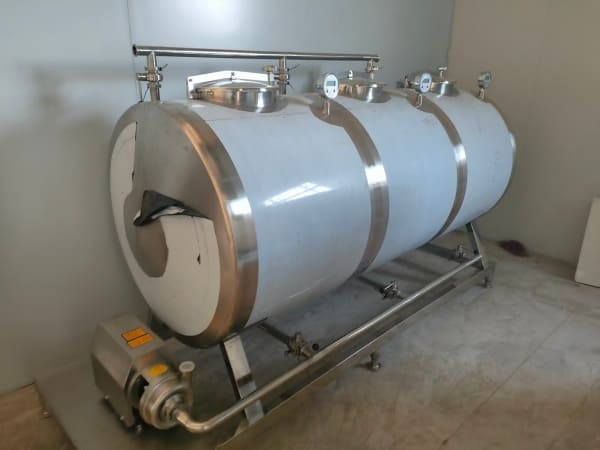
CIP Cleaning System
The proposed project includes a 300L × 3 CIP system.
The acid, alkali and hot-water tanks are made from 316L stainless steel.
The system includes:
- Acid tank
- Alkali tank
- Hot-water tank
- Product/cleaning pipelines
- Electric heating
- Circulation pumps
The heating power is:
36 kW
Two 20 t/h return pumps are included.
CIP is important for liquid fertilizer production because residues may remain inside mixing tanks, pipelines, pumps and filling equipment.
A properly configured CIP system can reduce manual cleaning work and improve production changeover efficiency.
The actual cleaning chemicals and cleaning parameters should be determined according to the customer’s fertilizer formulation.
Supporting Equipment for the Netherlands Project
The complete system also includes supporting equipment.
| Equipment | Specification / Function |
|---|---|
| Transfer Pump | 10 t/h, SUS304 wetted parts |
| Emulsification Pump | 0–8 m³/h, 7.5 kW |
| Duplex Filter | 50–200 mesh |
| Finished Product Tank | 10m³ |
| Small Bottle Filler | 12 heads, 100–1,000ml |
| Small Bottle Capper | Four-wheel |
| Induction Sealer | Φ20–60mm cap range |
| Labeling Machine | Round / square bottles |
| 20L Filling Machine | Weighing-type |
| 20L Capper | Automatic large-container capper |
| Coding Machine | Inkjet |
| Film Wrapper | Semi-automatic |
| Conveyor | Approx. 12m |
| CIP System | 300L × 3 |
| Return Pump | 20 t/h × 2 |
| Air Compressor | 1 m³ package |
| Control Cabinet | SUS304 |
| Stainless Steel Piping | SUS304 |
| Electrical System | Cables and cable trays |
Key Technical Points Before Finalizing the Project
For this Netherlands liquid fertilizer production line, four areas should be confirmed before the final equipment configuration is approved.
1. Bottle Drawings
The manufacturer should receive the final drawings for:
- 500ml bottle
- 1L bottle
- 5L bottle
- 20L bottle
The drawings should show bottle height, diameter, neck finish and other critical dimensions.
2. Preform Specifications
For PET bottle blowing, the preform information is equally important.
The machine needs to be matched with:
- Preform weight
- Preform length
- Preform neck
- Preform diameter
- PET material
3. Cap Specifications
The cap drawings should confirm:
- Cap diameter
- Cap height
- Thread
- Inner diameter
- Sealing structure
This determines whether different bottle sizes can use one cap specification.
4. Fertilizer Characteristics
The customer should provide:
- Product formulation
- Viscosity
- Density
- Foaming characteristics
- Filling temperature
- Whether suspended particles are present
These factors directly affect the filling machine, pump, filter and piping design.
Recommended Configuration for This Netherlands Project
Based on the current project information, the recommended configuration is:
Liquid Fertilizer Processing
3 × 5m³ mixing tanks → Emulsification → Filtration → 10m³ finished-product tank
1L Production
12-head inline filling machine → Four-wheel capping → Induction sealing → Labeling → Coding → Packaging
Target:
2,000 BPH
5L Production
Use a dedicated filling configuration suitable for 5L liquid fertilizer.
Target:
500–1,000 BPH
The 1L filling machine should not be used because its specified maximum filling volume is 1,000ml.
20L Production
20L weighing filling machine → Automatic large-container capping → Labeling → Coding → Packaging
Target:
500 BPH
Bottle Production
1L / 5L PET blow molding system
plus
20L blow molding system
plus
Bottle cap manufacturing machine
The exact machines should be matched to the final bottle and cap drawings.
A Complete Solution for Liquid Fertilizer Manufacturers in the Netherlands
This Netherlands project demonstrates why a liquid fertilizer production line should be designed as a complete system rather than as a collection of individual machines.
The customer needs to handle four different packaging formats, while the 1L bottle remains the primary product.
At the same time, bottle production, cap production, filling, capping and labeling need to work together.
The key is to match:
Product → Bottle → Preform → Cap → Filling Machine → Capping Machine → Labeling Machine → Packaging
When these specifications are coordinated from the beginning, the production line can provide greater flexibility for different fertilizer products and packaging sizes.
For fertilizer manufacturers in the Netherlands and other European markets, the final equipment configuration should also consider factory layout, utilities, production scheduling, cleaning requirements and future capacity expansion.
FAQ
Can one liquid fertilizer production line produce 500ml, 1L, 5L and 20L bottles?
Yes, a complete fertilizer production facility can handle all four formats. However, the filling and capping equipment should be configured according to the different bottle volumes. The 1L filling machine specified in this project cannot fill 5L or 20L containers.
Can the 500ml, 1L and 5L bottles use the same labeling machine?
Yes, this is technically possible if their dimensions and shapes fall within the labeling machine’s adjustment range. Adjustable bottle guides, sensors and labeling positions are required.
Can the 20L bottle use the same labeling machine?
It depends on the actual 20L bottle diameter, height and shape. Because 20L containers are much larger, a separate large-bottle labeling solution may be required.
Can 500ml, 1L and 5L bottles use the same cap?
Only if their bottle neck finishes and thread specifications are identical. Bottle capacity does not determine cap compatibility.
Can the 1L filling machine fill 5L fertilizer?
No. The proposed 12-head inline filling machine has a filling range of 100–1,000ml, so it cannot directly fill 5L containers.
Is the 12-head filling machine suitable for 1L fertilizer at 2,000 BPH?
Yes. Its stated rated capacity is up to 3,000 BPH and its filling range covers 1L. Therefore, it is suitable in terms of nominal capacity, subject to confirmation of product viscosity and foaming characteristics.
Is a four-head machine suitable for 20L fertilizer at 500 BPH?
A four-head weighing filling machine is a reasonable configuration for the 500 BPH target. Each head would handle approximately 125 bottles per hour. Final confirmation should be based on actual filling tests and product characteristics.
Can the 20L bottle-blowing machine produce 500 bottles per hour?
Not if the machine’s output is only 90 BPH. A 90 BPH machine can produce 90 bottles per hour, so bottles would need to be produced and stored in advance. If continuous 500 BPH filling is required, higher bottle-making capacity should be considered.
Can Zhongyilong provide the complete liquid fertilizer production line?
Yes. The project can be configured as a complete solution including liquid fertilizer mixing, emulsification, filtration, storage, filling, capping, sealing, labeling, coding, packaging, CIP, bottle blowing and cap production.
Request a Liquid Fertilizer Production Line Proposal
If you are planning a liquid fertilizer production line in the Netherlands, choosing the right equipment requires more than specifying bottles per hour.
The product formulation, bottle dimensions, bottle neck, cap design, filling volume, production capacity and labeling method all need to be considered together.
Zhongyilong can provide a customized solution for liquid fertilizer processing and packaging, including production tanks, filling machines, capping systems, labeling, CIP, PET bottle blowing and supporting equipment.
Send us your bottle drawings, cap specifications, fertilizer information and target production capacity to receive a customized technical proposal and equipment configuration.
WhatsApp: +86 19138171383
Email: zhongyilong@zylpacking.com