
Banana juice production requires a carefully designed processing system, especially when whole fresh bananas are used as the raw material. Unlike some fruit juice processes, bananas contain a high level of pulp and fiber, making raw material handling, enzymatic treatment, solid-liquid separation, and clarification particularly important.
A complete banana juice processing line integrates these stages into one continuous production system.
This article introduces a 6000kg/h banana processing solution designed to convert whole, unpeeled fresh bananas into clarified banana juice. The processed juice is then transferred to an existing UHT and aseptic carton packaging system.
The project is designed as an integrated turnkey processing solution, including raw material handling, washing, steam blanching, crushing, pulp cooling, antioxidant addition, enzymatic treatment, solid-liquid separation, juice clarification, CIP cleaning, automation, installation, commissioning, and operator training.
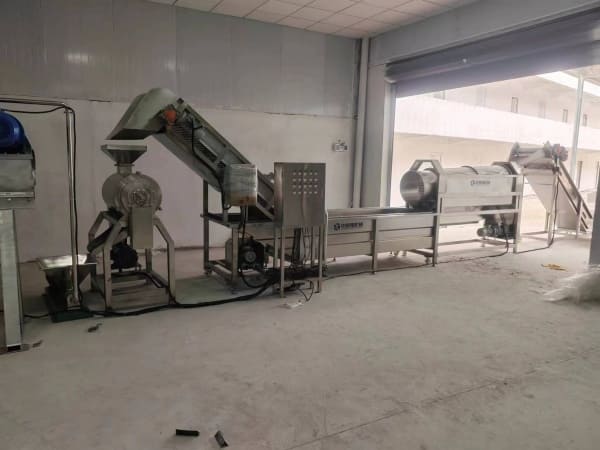
What Is a Banana Juice Processing Line?
A banana juice processing line is an integrated system designed to process fresh bananas into juice or clarified juice.
The equipment configuration depends on the final product requirements. For clarified banana juice, the production process must effectively handle banana pulp and fiber before the product enters downstream sterilization and packaging equipment.
The production flow for this project includes:
Fresh Banana Receiving → Washing → Steam Blanching → Crushing → Cooling and Antioxidant Addition → Enzymatic Treatment → Solid-Liquid Separation → Juice Buffering → Centrifugal Clarification → Transfer to UHT System
The line is designed to process approximately 6000kg of raw bananas per hour.
Raw Material Receiving and Washing
The production process begins with whole fresh bananas.
A roller-type elevator transfers bananas into the washing section. The equipment is designed for approximately 6 tons per hour of raw material handling capacity.
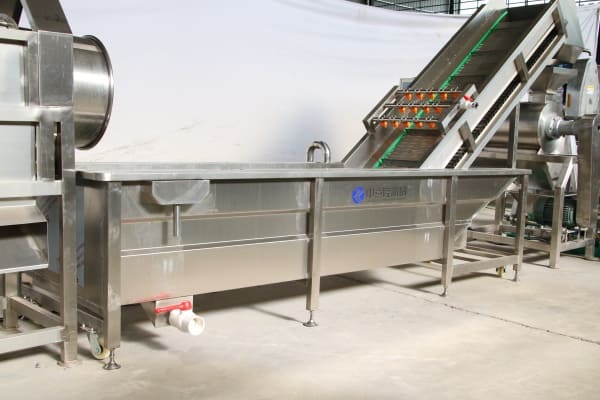
After receiving, the bananas enter a bubble washing machine.
The bubble washing process helps clean the surface of the bananas before further processing. Adjustable conveyor speed allows the washing process to be coordinated with the capacity of the entire production line.
For food processing applications, reliable washing equipment is essential because raw materials may contain dust, soil, and other external contaminants.
The washed bananas are then transferred to the blanching section.
Steam Blanching of Fresh Bananas
Steam blanching is an important stage in this banana processing solution.
The bananas are treated with steam for approximately 15 minutes to ensure that the material is heated thoroughly.
According to the process requirements, the banana temperature is expected to reach approximately 85°C to 100°C.
The blanching process is followed by material transfer to the crushing section.
Steam treatment can also be integrated with condensate collection and reuse systems as part of an efficient utility design.
The actual steam consumption should be calculated according to the final equipment design, operating conditions, and production requirements.
Banana Crushing and Pulp Preparation
After blanching, the bananas are transferred by an elevator to the crushing section.
A cutting and crushing machine processes the softened bananas into banana pulp.
For this production line, the target particle size of the processed banana pulp is approximately 600–800 microns.
Producing a controlled pulp consistency is important for the next processing stages, including cooling, antioxidant addition, enzymatic treatment, and solid-liquid separation.
The crushing system must also be properly matched to the 6000kg/h production capacity to maintain continuous material flow.
Pulp Cooling and Antioxidant Addition
After blanching and crushing, the banana pulp remains at an elevated temperature.
A tubular heat exchanger is used to cool the pulp from approximately 70°C to 50–60°C.
The cooled pulp is then suitable for the next processing stage.
At the same time, an ascorbic acid solution can be added online through the product transfer pipeline.
The system combines a single-screw pump with an antioxidant dosing arrangement.
Online antioxidant addition helps integrate ingredient dosing directly into the continuous processing flow.
Enzymatic Treatment System
Enzymatic treatment is a key stage in the clarified banana juice process.
The cooled banana pulp enters an enzymatic reaction tank equipped with a jacket and agitation system.
The operating temperature is designed to be maintained between 40°C and 60°C, with an enzymatic reaction time of approximately 30–60 minutes.
A dosing pump is used to add the required enzyme.
The final working volume and number of reaction tanks should be determined according to the required residence time and continuous production capacity of 6000kg/h.
Proper enzymatic treatment helps prepare the banana pulp for the following solid-liquid separation process.
Solid-Liquid Separation
After enzymatic treatment, the processed banana material enters the separation stage.
A decanter centrifuge is included in the proposed processing flow to separate coarse fibrous solids from the juice.
Because bananas contain significant amounts of fiber and pulp, effective solid-liquid separation is essential for producing clarified juice.
The project also considers an alternative configuration using a belt press instead of a decanter centrifuge.
Both solutions can be evaluated based on factors such as:
- Juice yield
- Product characteristics
- Operating costs
- Maintenance requirements
- Factory operating preferences
The final equipment selection should be confirmed according to the customer’s production objectives.
Juice Buffering and Centrifugal Clarification
After the initial separation process, the juice is transferred to a buffer or balance tank.
The buffer tank helps maintain stable product flow between processing stages.
The juice then enters a centrifugal separator for further clarification.
This equipment removes smaller suspended solids and helps produce a clearer juice before the product is transferred to the downstream UHT system.
The clarified juice quality, including turbidity requirements, should be defined according to the agreed production and product specifications.
For this project, performance requirements include maintaining the specified processing capacity and achieving the agreed clarified juice quality at the separator outlet.
Connection to Existing UHT and Packaging Equipment
This project focuses on the upstream banana juice processing section.
The customer already has UHT sterilization and Tetra Pak packaging equipment.
After clarification, the finished banana juice is transferred from the processing line to the existing UHT interface through sanitary pipelines and a centrifugal transfer pump.
This approach allows the new processing equipment to integrate with the customer’s existing downstream infrastructure.
A properly designed connection between the processing line and UHT system is important for maintaining continuous production and stable product transfer.
Automation and Control System
The banana juice processing line is designed with centralized automation.
The required control system includes a Siemens PLC and HMI.
Key functions include:
- Recipe and parameter control
- Process monitoring
- Alarm handling
- Production data recording
- Equipment coordination
Automation helps operators monitor the complete production process from raw material handling to clarified juice transfer.
The final automation scope should also define the brands and specifications of motors, VFDs, pneumatic components, valves, sensors, and process instruments.
CIP Cleaning System
Cleaning is an essential part of fruit juice processing.
The project includes a fully automatic CIP system for the new processing equipment.
The CIP system can be used to clean:
- Product pipelines
- Processing tanks
- Heat exchangers
- Pumps
- Valves
- Other product-contact equipment
Because banana juice processing involves pulp, fiber, and organic material, effective cleaning is particularly important for maintaining hygienic production conditions.
All product-contact equipment should also be designed with suitable food-grade materials and seals compatible with acidic products and CIP cleaning chemicals.
Key Technical Requirements for the Production Line
The processing system is designed around several important technical requirements.
Food-Grade Materials
Product-contact parts are specified as 316L stainless steel because the juice is acidic. Non-product-contact structural components are specified as at least 304 stainless steel.
Food-grade EPDM or equivalent sealing materials should also be compatible with both acidic products and CIP cleaning chemicals.
Production Capacity
The complete line is designed to process 6000kg of raw bananas per hour.
The expected clarified juice yield should be considered when selecting downstream storage and processing equipment.
Malaysian Electrical Standard
The electrical design is based on Malaysia’s local industrial power requirement of:
415V / 50Hz / 3 Phase
This is an important consideration for equipment installation and commissioning at the project site.
Testing and Commissioning
The project requirements include Factory Acceptance Testing (FAT) before shipment and Site Acceptance Testing (SAT) during commissioning.
Performance verification is based on the agreed production capacity and clarified juice quality requirements.
Benefits of an Integrated Banana Juice Processing Solution
A complete processing line provides several advantages compared with purchasing individual machines separately.
Continuous Processing
Each stage can be connected through conveyors, pumps, pipelines, and automated controls.
Better Process Coordination
Equipment capacity can be designed around the same 6000kg/h raw material throughput.
Reduced Manual Handling
Automated conveying and processing reduce unnecessary manual operations.
Easier Integration
The new processing line can connect directly with existing UHT and packaging equipment.
Customized Process Design
The configuration can be adjusted according to raw material characteristics, juice yield requirements, clarification targets, and factory conditions.
Conclusion
A 6000kg/h banana juice processing line provides a complete solution for converting whole fresh bananas into clarified juice.
The process integrates raw material receiving, washing, steam blanching, crushing, pulp cooling, antioxidant addition, enzymatic treatment, solid-liquid separation, centrifugal clarification, and automated product transfer.
For manufacturers that already have UHT and aseptic packaging equipment, an integrated upstream processing system can provide an efficient way to expand production capacity while using existing downstream infrastructure.
The success of a banana juice project depends on more than individual equipment. Raw material characteristics, juice yield, enzymatic treatment, separation technology, clarification requirements, automation, CIP cleaning, utilities, and downstream integration should all be considered during system design.
A properly engineered turnkey solution can help manufacturers build a more efficient and coordinated banana juice processing operation.
FAQ
1. What is included in a banana juice processing line?
A complete line can include banana receiving equipment, washing machines, steam blanching equipment, crushers, heat exchangers, enzymatic reaction tanks, separation equipment, juice tanks, centrifugal separators, transfer pumps, automation systems, and CIP cleaning equipment.
2. What is the production capacity of this banana processing line?
The project is designed to process approximately 6000kg of raw bananas per hour.
3. Why is enzymatic treatment used in banana juice processing?
The process uses an enzymatic reaction stage before solid-liquid separation. The reaction conditions are designed around controlled temperature and residence time requirements.
4. What equipment is used for banana juice clarification?
The processing flow includes initial solid-liquid separation followed by centrifugal clarification to remove smaller suspended solids.
5. Can the line connect to an existing UHT system?
Yes. This project is specifically designed to transfer clarified juice to the customer’s existing UHT and aseptic packaging interface.
6. What material is used for product-contact equipment?
According to the project requirements, product-contact parts use 316L stainless steel, while non-product-contact structural components use at least 304 stainless steel.
7. Is the banana juice processing line automated?
Yes. The project requires a Siemens PLC and HMI system with parameter control, alarm handling, and data recording functions.
8. Can the processing system be customized?
Yes. The final configuration can be adjusted according to production capacity, juice yield requirements, separation technology, automation level, factory layout, and downstream equipment integration.