
Producing clear apple juice concentrate requires stable clarification before the juice enters the evaporation process. For juice processors, the filtration system must not only remove suspended solids and reduce turbidity, but also maintain high product recovery and minimize the loss of valuable soluble components.
A juice concentrate producer in Georgia is currently looking for a complete ceramic tangential flow membrane filtration system for its apple juice processing facility.
The customer processes approximately 5,000 metric tons of apples per season using Bucher pneumatic presses. The final product is clear apple juice concentrate with a target concentration of approximately 70 °Bx. The concentrate is packed in aseptic bags inside 200-liter steel drums.
The proposed membrane filtration system will be installed before evaporation, processing single-strength apple juice at approximately 10–14 °Bx.
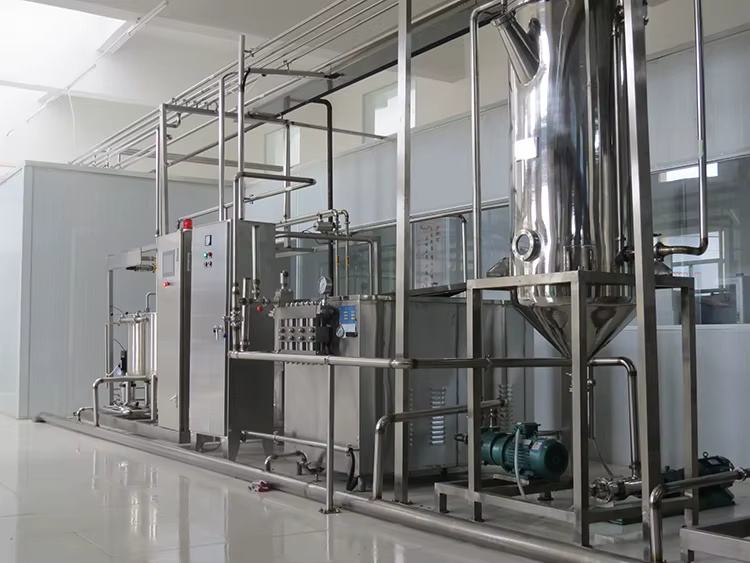
Project Overview
The main customer requirements can be summarized as follows:
| Project Item | Customer Requirement |
|---|---|
| Project Location | Georgia |
| Raw Material | Fresh apples |
| Annual Seasonal Processing | Approximately 5,000 metric tons |
| Pressing Equipment | Bucher pneumatic press |
| Product | Clear apple juice concentrate |
| Final Concentration | Approximately 70 °Bx |
| Filtration Position | Before evaporation |
| Filtration Feed | Approximately 10–14 °Bx apple juice |
| Juice pH | Approximately 3.0–4.0 |
| Minimum Net Permeate Capacity | 5 m³/h |
| Optional Capacity | 7 m³/h |
| Preferred Technology | Inorganic ceramic membrane |
| Electrical Supply | 400 V / 3 Phase / 50 Hz |
| Installation Location | Georgia |
These requirements provide the basis for selecting the membrane technology, filtration area, pumps, heat exchanger, CIP system, instrumentation, and automation.
Why Ceramic Crossflow Filtration for Apple Juice?
Clarification is an important stage in the production of clear apple juice concentrate.
The customer is specifically looking for a ceramic tangential or crossflow membrane filtration system. Unlike conventional dead-end filtration, crossflow filtration continuously circulates the juice across the membrane surface.
The objective is to produce a clear juice stream suitable for downstream evaporation while maintaining stable filtration performance.
The target permeate quality includes:
- Clear apple juice suitable for producing 70 °Bx concentrate
- Turbidity preferably ≤1 NTU
- No visible suspended solids
- Maximum retention of sugars
- Maximum retention of aroma and color
- High recovery of soluble components
- Product recovery preferably at 95–97%
The customer also requires stable filtration performance throughout the production batch.
Importantly, the required 5 m³/h capacity must be demonstrated using actual apple juice after normal membrane fouling has stabilized. It should not be based only on pure-water flux or circulation pump capacity.
This requirement provides a more realistic basis for evaluating the actual performance of the filtration system.
Main Requirements for the Ceramic Membrane System
The membrane supplier needs to provide detailed information about the proposed ceramic membrane.
Important technical parameters include:
| Membrane Parameter | Required Information |
|---|---|
| Membrane Type | Inorganic ceramic membrane |
| Manufacturer | Manufacturer and country of origin |
| Ceramic Material | Alumina, zirconia, titania or other material |
| Membrane Specification | Recommended pore size or molecular weight cut-off |
| Membrane Area | Total installed membrane area |
| Membrane Elements | Quantity, dimensions and price |
| Channel Diameter | Membrane channel diameter |
| Flux | Initial and stabilized apple juice flux |
| Operating Temperature | Recommended operating range |
| Operating Pressure | Recommended pressure |
| Crossflow Velocity | Recommended crossflow speed |
| TMP | Recommended transmembrane pressure |
| Service Life | Expected membrane lifetime |
| Replacement | Replacement cost and spare parts availability |
Providing these parameters allows the customer to compare different membrane solutions based on actual processing requirements rather than simply comparing equipment prices.
Complete Filtration System Configuration
The customer requires a complete filtration skid rather than membrane modules alone.
The proposed system should include feed and circulation pumps, ceramic membrane modules, stainless steel housings, a product heat exchanger, automated process controls, instrumentation, and CIP equipment.
The main configuration can be summarized as follows:
| System Section | Main Equipment | Function |
|---|---|---|
| Juice Feeding | Feed Pump | Transfers apple juice into the filtration system |
| Membrane Circulation | Circulation Pump | Maintains crossflow through membrane channels |
| Filtration | Ceramic Membrane Modules | Clarifies apple juice |
| Housing | Stainless Steel Housing | Supports hygienic membrane installation |
| Temperature Control | Product Heat Exchanger | Controls juice temperature |
| Process Control | Automatic Valves and PLC/HMI | Controls filtration cycles |
| Monitoring | Flow, Pressure, Temperature, Turbidity and Conductivity Instruments | Monitors process conditions |
| Product Recovery | Automatic Recovery Cycle | Reduces product losses |
| Discharge | Automatic Drain/Discharge System | Controls product and cleaning discharge |
| Cleaning | Automatic CIP System | Cleans the complete filtration system |
The final equipment layout should be developed according to the selected membrane configuration and the customer’s factory conditions in Georgia.
Upstream Apple Juice Treatment
Membrane performance depends strongly on the quality of the juice entering the filtration system.
For this reason, the customer is requesting recommendations for the upstream treatment process.
The supplier should evaluate:
- Screen size before membrane filtration
- Enzyme type
- Enzyme dosage
- Enzymatic treatment temperature
- Reaction time
- Depectinization testing
- Possible use of clarification agents
- Possible flotation treatment
- Maximum allowable suspended solids before filtration
Proper depectinization is particularly important because the filtration system is intended to process apple juice before evaporation.
The actual upstream process should be confirmed through product testing rather than selected only from theoretical assumptions.
Automatic CIP Cleaning System
A complete automatic CIP system is another important requirement of the project.
The CIP system should be capable of cleaning the membrane modules, product pipelines, pumps, heat exchanger, valves, and other product-contact components.
The customer requires cleaning programs for:
- Alkaline cleaning
- Acid cleaning
- Enzymatic cleaning
The system should also include CIP heating and chemical dosing equipment.
Automated cleaning helps standardize the cleaning procedure and allows the filtration system to return to production with less manual intervention.
The supplier should provide expected CIP water consumption and chemical consumption as part of the technical proposal.
Process Monitoring and Automation
The filtration system requires an English-language PLC/HMI control system.
The control system should support automatic operation and data recording.
Key process parameters include:
- Flow rate
- Pressure
- Temperature
- Turbidity
- Conductivity
The automation system should also control the required filtration, concentration, recovery, discharge, and cleaning cycles.
Remote technical support is another requirement for this international project.
For a production facility in Georgia, remote access and technical assistance can help operators troubleshoot process conditions and maintain stable equipment operation.
Food-Grade Construction and Materials
Because the system processes acidic apple juice with a pH of approximately 3.0–4.0, suitable food-grade materials are required for product-contact components.
The customer prefers AISI 316L stainless steel for product-contact parts.
The complete system should also include the necessary:
- Sanitary valves
- Product pipelines
- Process instruments
- Electrical cabinets
- Food-contact components
The supplier should provide the required food-contact certificates together with the technical proposal.
Capacity and Product Recovery
The minimum required net permeate processing capacity is 5 m³/h.
The customer also requests an optional quotation for a 7 m³/h system.
However, capacity is not the only performance indicator.
The filtration system should also focus on:
Stable Flux + Low Turbidity + High Product Recovery + Low Juice Loss
The target product recovery is preferably 95–97%.
This is important because apple juice contains valuable soluble solids, including sugars, and unnecessary product loss can directly affect the economics of concentrate production.
The customer therefore requires the supplier to provide information regarding expected juice loss, soluble solids loss, and final concentrate quantity.
Utilities and Factory Planning in Georgia
A complete technical proposal should include estimated utility consumption.
The customer specifically requires information regarding:
- Electricity
- Water
- Compressed air
- Steam
- CIP water
- CIP chemicals
- Total installed power
- Normal operating power
The electrical requirement for the project is:
400 V / 3 Phase / 50 Hz
The equipment layout and detailed process flow diagram should also be included to help the customer evaluate installation requirements at the Georgian production facility.
Installation, Commissioning and Technical Support
For an international membrane filtration project, technical support is an important part of the overall solution.
The customer requests the supplier to include:
- Delivery time
- Warranty terms
- Installation and commissioning costs in Georgia
- Operator training
- Recommended spare parts
- CE certification
- Food-contact certificates
These items should be clearly stated in the final commercial and technical proposal.
A complete project solution should cover not only equipment manufacturing, but also installation, commissioning, training, documentation, and after-sales support.
What Should Be Included in the Final Technical Proposal?
To make equipment evaluation easier, the supplier should provide a complete technical and commercial package.
The proposal should include:
| Proposal Section | Required Information |
|---|---|
| Process Design | Detailed process flow diagram |
| Equipment | Complete equipment list |
| Membrane | Material, area, elements and specifications |
| Performance | Initial and stabilized flux |
| Capacity | 5 m³/h minimum and optional 7 m³/h |
| Product Quality | Turbidity and suspended solids targets |
| Recovery | Expected product recovery and losses |
| Utilities | Water, electricity, steam and compressed air |
| CIP | Water, chemical consumption and cleaning cycles |
| Layout | Equipment arrangement and dimensions |
| Automation | PLC/HMI and data recording |
| Service | Installation, commissioning and training |
| Documentation | CE and food-contact certificates |
| Commercial | Delivery time, warranty and spare parts |
A detailed proposal makes it easier to evaluate the complete lifecycle cost and expected processing performance of the system.
Conclusion
This Georgia apple juice project requires a complete ceramic crossflow membrane filtration system for clarifying single-strength apple juice before evaporation.
The customer processes approximately 5,000 metric tons of apples per season and requires a minimum net permeate capacity of 5 m³/h, with a 7 m³/h option for comparison.
The target is to produce clear apple juice suitable for concentration to approximately 70 °Bx, with turbidity preferably at or below 1 NTU, no visible suspended solids, high retention of valuable soluble components, and product recovery preferably between 95% and 97%.
The success of the system will depend on more than membrane selection. Upstream depectinization, feed quality, membrane flux, operating conditions, CIP performance, automation, utility consumption, and product recovery should all be considered during engineering.
For an apple juice concentrate producer in Georgia, a properly designed ceramic membrane filtration system can provide an important clarification step between pressing and evaporation while supporting stable and efficient juice processing.
FAQ
1. What type of membrane is required for this apple juice project?
The customer prefers an inorganic ceramic membrane filtration system using tangential or crossflow technology.
2. What is the required filtration capacity?
The minimum required net permeate capacity is 5 m³/h. A 7 m³/h system is also requested as an optional solution.
3. What concentration is the apple juice before filtration?
The expected filtration feed concentration is approximately 10–14 °Bx.
4. What is the final apple juice concentrate concentration?
The target final concentration is approximately 70 °Bx.
5. What turbidity is required?
The customer prefers a clarified apple juice permeate with turbidity of ≤1 NTU and no visible suspended solids.
6. What product recovery is expected?
The preferred product recovery is approximately 95–97%, while minimizing juice and soluble solids losses.
7. Why is upstream depectinization important?
The customer specifically requires recommendations for enzyme treatment and depectinization before membrane filtration. Actual treatment conditions should be confirmed through testing.
8. Does the system require automatic CIP?
Yes. The project requires a complete automatic CIP system with alkaline, acid, and enzymatic cleaning programs.
9. Where will the system be installed?
The project installation location is Georgia.
10. Can the membrane system be customized?
Yes. The final membrane area, membrane elements, pumps, heat exchanger, CIP system, automation, layout, and utilities should be designed according to the customer’s actual apple juice and factory conditions.
Request a Customized Apple Juice Filtration Solution
Are you planning an apple juice concentrate production project in Georgia or another market?
Choosing the right membrane technology is only the first step. The filtration system should be designed around your actual juice characteristics, production capacity, target turbidity, recovery requirements, CIP process, and factory utilities.
We can provide a customized solution covering:
- Ceramic membrane filtration
- Apple juice clarification
- Upstream depectinization
- Automatic CIP
- Process automation
- Equipment layout
- Utility calculations
- Installation and commissioning
Send us your apple processing capacity, juice °Bx, pH, required filtration capacity, and target product quality. Our engineering team can evaluate your requirements and prepare a customized technical solution and quotation for your project.