
From raw well water to bottle-grade pure water — how a multi-stage reverse osmosis chain is specified, sized, and integrated with a beverage bottling line.
The Water Treatment Imperative
A water treatment system is, at its core, an engineered process that strips raw water of impurities, contaminants, and dissolved solids until the output meets a defined quality standard. Whether the end use is drinking water supply, industrial process water, or — as in the source materials studied here — feed water for a bottled-water production line, the logic is the same: the design must be matched to the quality of the incoming raw water and the purity demanded at the discharge end. The U.S. Environmental Protection Agency describes reverse osmosis (RO) as a pressure-driven process in which water is forced through a semi-permeable membrane, leaving most dissolved contaminants behind (EPA, WaterSense). Building a complete, reliable system around that single principle is where the engineering begins.
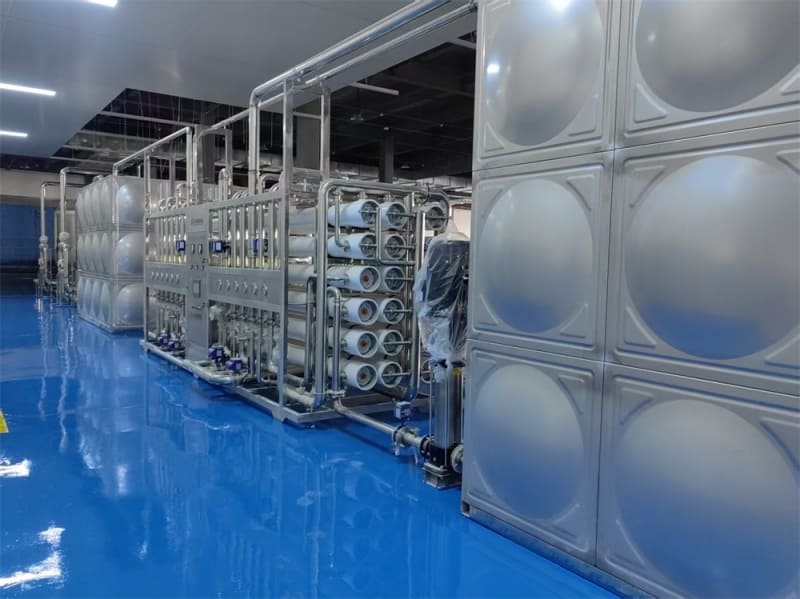
Anatomy of the Treatment Chain
No reverse osmosis membrane can survive raw groundwater unaided. A robust system is always a sequence — a graded staircase of filtration that removes progressively smaller threats before the water ever reaches the high-pressure pump. The configuration documents for 1–10 ton-per-hour (t/h) single-stage RO units reveal a consistent, repeatable architecture built from five stages.
Pre-Treatment: The First Line of Defense
The first three stages protect the membrane, and their specifications are remarkably stable across capacities. Multi-media (quartz sand) filtration acts as a mechanical interceptor: raw water passes downward through graded quartz layers (typical gradation 2–4–8–16), capturing suspended solids and turbidity. According to the technical data, influent at 10–20 mg/L is reduced to 2–5 mg/L effluent, with a dirt-holding capacity of 5–15 kg/m³ and a filtration velocity of 10–12 m/h. Backwashing — sometimes with air–water mixed scouring — prevents the bed from caking and restores its interception capacity.
Activated carbon filtration follows, exploiting carbon’s enormous porous surface area to adsorb organics, colloids, heavy metals, and — critically — residual chlorine. Performance data show influent chlorine as high as 9 mg/L being cut to an effluent below 0.1 ppm. This stage is non-negotiable: free chlorine oxidizes and destroys polyamide RO membranes, so dechlorination at this point is what keeps the downstream core alive. Both filter vessels are typically glass-reinforced plastic (FRP) for smaller systems, with stainless steel or rubber-lined carbon steel as an upgrade path.
The final pre-treatment guard is the precision (security) filter — a stainless-steel housing holding 5 μm PP melt-blown cartridges. Rated between sand filtration and ultrafiltration (0.1–120 μm pore range), it captures whatever fine particles slip through the carbon bed, providing the last physical barrier before the high-pressure pump and membrane.
The Reverse Osmosis Core
Once pre-treated, water enters the heart of the system. A high-pressure pump raises the feed pressure above the natural osmotic pressure, reversing the flow of water molecules through the semi-permeable RO membrane. The feed stream splits into two: permeate (product water that passes through the membrane) and concentrate (the rejected brine carrying the salts, carried out via the concentrate port). A single-stage RO membrane system achieves a desalination rate of 97% or higher.
Membrane selection is dictated by required output. Two element sizes dominate the market. The 4040 element — roughly 4.0 inches in diameter and 40 inches long — yields about 0.33 t/h and is used on smaller skids (1–4 t/h). The 8040 element — 8.0 inches by 40 inches — produces roughly 1.25 t/h per element and scales the system from 5 t/h upward. The configuration tables make this scaling explicit: a 4 t/h system uses four 8040 membranes in two 8-inch housings, while a 10 t/h system deploys eight 8040 elements across five housings.
Where single-stage RO cannot meet tighter purity targets, a double-stage system passes the permeate through a second RO bank. Double-stage RO can push conductivity to about 10 μS/cm and remove more than 98% of dissolved salts and 99% of colloids, microorganisms, and organic matter — the benchmark for modern pure-water applications.
Instrumentation closes the loop on every skid: concentrate and permeate flow meters, inlet and concentrate pressure gauges (stainless-steel oil-filled for vibration damping), and a conductivity meter on the product line that reports the real-time desalination result. High/low-pressure protection switches safeguard the pump, and a manual concentrate regulating valve sets the system recovery ratio.
Beyond RO: Nanofiltration, Ultrafiltration, and EDI
Reverse osmosis is one node in a wider membrane-separation family, and selecting the right technology means matching filtration precision to the job. The three differ in what they let through.
| Technology | Pore / Precision | Operating Pressure | Typical Application |
|---|---|---|---|
| Ultrafiltration (UF) | 0.03–1 μm | 1–7 bar | Drinking water, process water, retaining beneficial minerals |
| Nanofiltration (NF) | ~0.001 μm (1 nm) | 3.5–30 bar | Water softening, color removal, juice concentration |
| Reverse Osmosis (RO) | ~0.0001 μm | 12–70 bar | Seawater desalination, high-purity and bottled water |
NF, often called “low-pressure RO,” sits between UF and RO — it lets most monovalent ions pass while rejecting divalent ions and molecules above 200 Da, making it ideal for softening and decolorization without full desalination. For the very highest purity, EDI (Electrodeionization) electrodialysis and ion exchange into a single, chemical-free process achieves 15–17 MΩ·cm ultrapure water with a utilization rate of 90–99%.
Sizing and Configuration
From 1 to 10 Tons Per Hour
The eight configuration sheets — 1, 2, 3, 4, 5, 6, 8, and 10 t/h — trace a clean scaling logic. Below 4 t/h, systems run on 4040 membranes, FRP filter vessels of 300–600 mm diameter, and 20-inch precision cartridges. From 5 t/h upward, the design shifts decisively to 8040 membranes, 8-inch housings, 40-inch cartridges, and larger FRP tanks (750 mm at 5 t/h rising to 1200 mm at 10 t/h). Pump power climbs in step, from a 0.75 kW booster and 1.5 kW high-pressure pump at 1 t/h to substantially larger multistage centrifugal units at 10 t/h. Every skid is unified by the same five-stage recipe, PVC piping at 1.6 MPa, a stainless-steel frame, and a matched electrical control system.
Integrating With the Bottling Line
Water treatment never exists in isolation. In a bottled-water plant, its capacity is back-calculated from the filling line’s throughput, the bottle volume, and the rinse-water consumption of the 3-in-1 rinser-filler-capper. The rule of thumb from the production-line documentation is explicit: a 2,000-bottles-per-hour line filling 500 ml bottles needs a 1,000 L/h treatment plant, but adding the wash-water draw of an 8-8-3 rinsing unit pushes the specification to 1,500–2,000 L/h. The RO permeate then feeds a UV sterilizer and an ozone generator with a mixing pump in the pure-water tank — the ozone dissolves into the stored water to extend shelf life before the water ever reaches the filler.
Economics and Lifecycle Management
The pricing tables for the full RO family illustrate how cost scales with capacity and purity tier. Single-stage systems range from roughly ¥14,000 for a 1 t/h stainless-steel unit to about ¥118,000 for a 10 t/h stainless-steel skid. Double-stage RO commands a premium — ¥25,000 at 1 t/h up to ¥195,000 at 10 t/h — while seawater desalination systems, demanding high-pressure, high-salinity operation, run from ¥78,000 at 0.2 t/h to ¥640,000 at 10 t/h.
Acquisition cost, however, is only the first line of the ledger. Two lifecycle levers determine true operating economics. First, antiscalant dosing — a 1:10 diluted dispersant injected before the membrane to prevent calcium carbonate, sulfate, and iron-oxide scaling — extends cleaning intervals and protects membrane life. Second, the RO membranes themselves are consumables with a service life of roughly two to three years; disciplined flushing and chemical cleaning can stretch that window. Because replacement elements are the dominant recurring cost, protecting them through proper pretreatment and dosing is where engineering discipline converts directly into money saved.
Conclusion
A reverse osmosis water treatment system is best understood not as a single machine but as a choreographed sequence. Each stage — sand, carbon, security cartridge, high-pressure pump, membrane, sterilization — exists to relieve the next stage of a specific burden, and the whole chain is sized to the line it serves. Whether the target is a 1 t/h skid feeding a small filler or a 10 t/h plant supplying a high-speed bottling line, the engineering principles do not change: protect the membrane, match the output to the demand, and treat lifecycle cost as a design variable rather than an afterthought. Purity, in the end, is an engineered outcome.
Reference URLs
Technical reference: U.S. EPA — Point-of-Use Reverse Osmosis Systems
Membrane filtration guidance: U.S. EPA — Membrane Filtration Guidance Manual