
Modern beverage manufacturing requires more than a reliable filling machine. Before a beverage reaches the filling stage, raw materials must be extracted, processed, blended, homogenized, sterilized, and prepared under controlled conditions.
An aseptic beverage premixing system is designed to manage these critical processes efficiently.
For manufacturers producing juice beverages, fermented drinks, plant-based beverages, tea drinks, functional beverages, and other liquid products, the premixing stage has a direct impact on product consistency, production efficiency, hygiene, and final product quality.
A complete system can integrate extraction, blending, filtration, homogenization, UHT sterilization, degassing, CIP cleaning, heat management, and automated control into one coordinated processing solution.
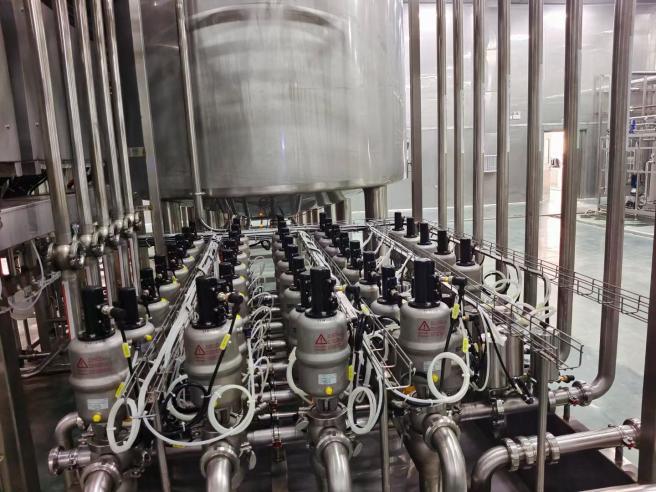
What Is an Aseptic Beverage Premixing System?
An aseptic beverage premixing system is an integrated processing solution used before the filling stage of beverage production.
Its primary function is to prepare liquid products according to the required production process. Depending on the beverage type, the system may include raw material extraction, ingredient mixing, emulsification, filtration, homogenization, sterilization, cooling, degassing, and storage.
Unlike a simple mixing tank, a complete premixing system connects multiple processing units into an automated production process.
The system can be designed according to different beverage categories and production requirements.
Typical applications include:
- Fruit juice and juice beverages
- Tea beverages
- Fermented beverages
- Plant-based beverages
- Functional drinks
- Concentrated extract beverages
- Carbonated beverage premixing
- Other liquid food products
Why Is the Premixing Process Important?
The premixing stage is one of the most important parts of a beverage production line.
Before filling, the product must meet specific requirements for formulation, temperature, stability, microbiological safety, and processing consistency.
A properly designed premixing system helps manufacturers achieve several important goals.
Consistent Product Quality
Automated blending and ingredient control help maintain consistent formulations between production batches.
Accurate flow measurement, weighing systems, temperature monitoring, and automated process control can reduce manual errors during production.
Improved Production Efficiency
Instead of operating individual machines independently, an integrated system connects extraction, mixing, sterilization, and transfer processes.
This improves production continuity and reduces unnecessary handling.
Better Hygiene Control
Food-grade stainless steel equipment, CIP cleaning systems, sanitary pipelines, and automated valves help support hygienic beverage production.
Flexible Product Production
A well-designed system can be adapted for different beverage formulations.
For example, one production facility may need to process fruit juice beverages, fermented products, and extracted concentrates.
The processing equipment should therefore be designed around the actual product characteristics rather than using a one-size-fits-all solution.
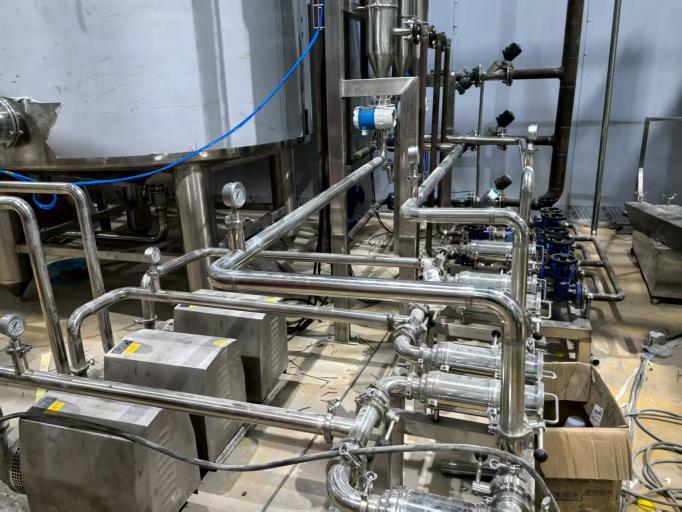
Main Components of an Aseptic Beverage Premixing System
A complete beverage premixing solution can include several functional processing units.
The exact configuration depends on the beverage type, production capacity, formulation, and required process.
1. Extraction System
For tea beverages, herbal drinks, botanical extracts, and other products that require raw material extraction, the extraction system is an important part of the production process.
The system may include:
- Extraction tanks
- Material transfer pumps
- Filtration equipment
- Flow meters
- Residue discharge equipment
- Plate heat exchangers
- Settling tanks
- Disc separators
- Clear liquid storage tanks
The purpose of the extraction process is to obtain the desired liquid ingredients while separating solid materials and controlling the process conditions.
After extraction, the product can be transferred to the next stage for clarification, blending, or further processing.
2. Juice Blending and Mixing System
The juice blending system is responsible for combining water, juice concentrate, sugar, stabilizers, acids, flavors, and other ingredients according to the product formulation.
A typical blending system may include:
- Mixing tanks
- Emulsification tanks
- Blending tanks
- Material pumps
- Flow meters
- Bag filters
- Magnetic filters
- Weighing modules
- Acid adjustment tanks
Automated or semi-automated ingredient handling helps improve formulation consistency and production efficiency.
For beverage manufacturers producing multiple products, the blending system should also provide sufficient flexibility for recipe changes and production adjustments.
3. Emulsification and Homogenization
Some beverage products contain ingredients that need to be uniformly dispersed.
Emulsification and homogenization help improve product stability and consistency.
This process can be particularly important for products containing:
- Fruit pulp
- Plant proteins
- Dairy ingredients
- Oils
- Flavors
- Stabilizers
- Functional ingredients
A homogenizer applies mechanical force to reduce particle size and improve the uniformity of the liquid.
The correct homogenization process depends on the product formulation and process requirements.
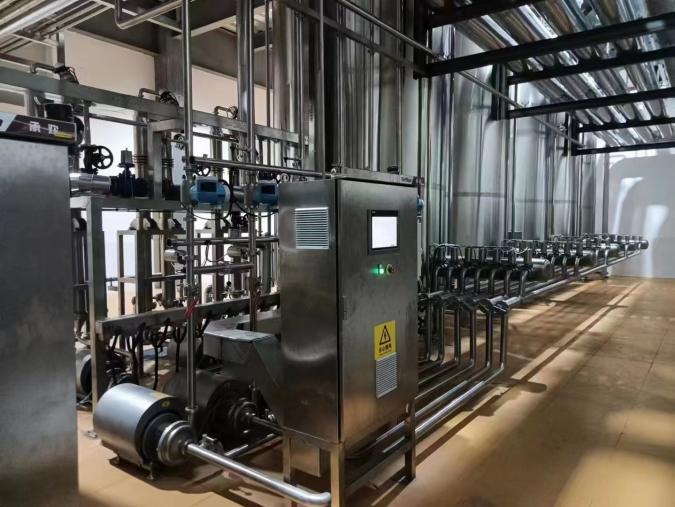
4. UHT Sterilization System
UHT sterilization is an important processing stage for many shelf-stable beverage products.
The product is heated to the required sterilization temperature for a controlled holding time before being cooled for the next production stage.
An integrated UHT system can help manufacturers achieve continuous thermal processing.
Key factors include:
- Product flow rate
- Inlet temperature
- Sterilization temperature
- Holding time
- Heat recovery
- Outlet temperature
- Automation control
The appropriate sterilization parameters should always be determined according to the product characteristics and process requirements.
5. Degassing System
Some beverage products require degassing before filling or further processing.
A degassing system removes unwanted gases from the product and can support improved product stability and processing performance.
The system typically operates with vacuum technology and automated control.
Degassing can be integrated into the overall processing line together with homogenization and sterilization equipment.
6. CIP Cleaning System
Cleaning is essential for beverage processing equipment.
A CIP (Clean-in-Place) system allows tanks, pipelines, pumps, valves, heat exchangers, and other processing equipment to be cleaned without extensive manual disassembly.
A typical CIP cleaning system may include:
- Alkali tank
- Acid tank
- Hot water tank
- Clean water tank
- Heating system
- Supply pumps
- Filters
- Pneumatic valves
- Conductivity monitoring
- Temperature monitoring
- Pressure monitoring
- Automated control system
A properly designed CIP system helps improve cleaning efficiency and supports hygienic production.
7. Hot Water and Utility System
Temperature control is required throughout many beverage processing stages.
A hot water system can provide process heat for equipment such as heat exchangers, mixing systems, and cleaning systems.
The system may include:
- Hot water storage tanks
- Hot water generation units
- Circulation pumps
- Steam control valves
- Temperature sensors
- Pressure instruments
- Automated control cabinets
An integrated utility system helps maintain stable operating conditions across the production line.
Automation and Process Control
Automation is an important part of modern beverage production.
A centralized control system can connect major processing equipment and monitor important operating parameters.
Typical control functions may include:
- Pump control
- Valve control
- Temperature monitoring
- Flow measurement
- Liquid level monitoring
- Pressure monitoring
- CIP process control
- Production sequence management
PLC and HMI systems allow operators to monitor the production process more efficiently.
Automated control can also help reduce manual operation and improve process repeatability.
Designing a System for Different Beverage Products
Different beverages require different processing technologies.
A juice beverage may require blending, filtration, homogenization, sterilization, and degassing.
A tea beverage may require extraction, clarification, cooling, and blending.
A fermented beverage may require specialized fermentation and processing conditions.
For this reason, beverage manufacturers should not simply purchase standard equipment without considering the complete production process.
A professional system design should evaluate:
- Product type
- Raw materials
- Production capacity
- Product formulation
- Processing technology
- Required automation level
- Factory layout
- Utility conditions
- Cleaning requirements
- Future expansion plans
The goal is to create a processing system that works as a complete production solution.
From Premixing to Filling
The aseptic premixing stage is only one part of the complete beverage production process.
After the product has been prepared, it can continue to the filling and packaging section.
A complete beverage factory may include:
- Water treatment
- Raw material preparation
- Extraction or ingredient processing
- Blending and mixing
- Homogenization
- Degassing
- UHT sterilization
- Aseptic or hot filling
- Bottle capping
- Labeling
- Date coding
- Secondary packaging
- Palletizing
By integrating these processes, manufacturers can build a more efficient and coordinated production system.
Benefits of a Complete Aseptic Premixing Solution
Investing in an integrated beverage premixing system can provide several advantages.
Integrated Process Design
Multiple processing units can be connected into one complete production system.
Improved Production Efficiency
Automated equipment reduces unnecessary manual handling and improves production continuity.
Consistent Product Processing
Controlled temperature, flow, pressure, and mixing parameters help improve process repeatability.
Hygienic Production
Food-grade stainless steel equipment and CIP cleaning systems support hygienic operation.
Flexible Production
The system can be designed to accommodate different beverage categories and production requirements.
Easier Future Expansion
A modular production layout can make it easier to add equipment or increase capacity in the future.
How to Choose the Right Aseptic Beverage Premixing System
When selecting a beverage premixing system, manufacturers should first define their actual production requirements.
Important questions include:
- What type of beverage will be produced?
- Is extraction required?
- Does the product require homogenization?
- What sterilization process is needed?
- What production capacity is required?
- How many product formulations will be produced?
- Is automatic CIP cleaning required?
- What level of automation is needed?
- How much factory space is available?
- Are future production upgrades planned?
The best solution is usually not the equipment with the most functions.
Instead, it should be a system designed around the actual product, process, capacity, and factory requirements.
Conclusion
An aseptic beverage premixing system is a critical part of modern beverage manufacturing.
By integrating extraction, blending, filtration, emulsification, homogenization, UHT sterilization, degassing, CIP cleaning, utility systems, and automation, manufacturers can create a more efficient and controlled production process.
Whether producing fruit juice, tea beverages, fermented drinks, plant-based beverages, or functional beverages, the premixing system should be customized according to the specific product and process requirements.
A properly designed solution can help improve product consistency, production efficiency, hygiene management, and overall factory integration.
For beverage manufacturers planning a new production facility or upgrading an existing line, working with an experienced equipment supplier can help ensure that every stage—from raw material processing to final filling—is properly connected.
FAQ
1. What is an aseptic beverage premixing system?
An aseptic beverage premixing system is an integrated processing solution used to prepare beverages before the filling stage. It can include extraction, mixing, filtration, homogenization, sterilization, degassing, storage, CIP cleaning, and automation.
2. What beverages can be produced with a premixing system?
Depending on the equipment configuration, the system can be used for fruit juice, tea beverages, fermented drinks, plant-based beverages, functional beverages, concentrated extracts, and other liquid products.
3. Is UHT sterilization included in a beverage premixing system?
It can be included depending on the product requirements. UHT sterilization is commonly integrated into processing systems for beverages that require continuous high-temperature treatment.
4. Why is CIP important in beverage production?
CIP allows tanks, pipelines, pumps, valves, and other equipment to be cleaned internally without frequent manual disassembly. This improves cleaning efficiency and supports hygienic production.
5. Can one system produce different beverage products?
Yes. A properly designed system can be configured for multiple products. However, the final design should consider the specific processing requirements of each beverage.
6. How do I choose the right beverage premixing system?
The system should be selected according to the beverage type, formulation, production capacity, processing technology, automation requirements, factory layout, and future expansion plans.