
Understanding Reverse Osmosis Plant Design
Reverse osmosis (RO) has become one of the most widely used technologies for producing purified water. Over the years, improvements in membrane materials, pretreatment, energy recovery, automation, and system design have made RO plants more efficient and reliable.
The development of modern RO systems has been driven by the growing need for high-quality water in municipal, industrial, food and beverage, pharmaceutical, and other applications.
A well-designed reverse osmosis plant is more than a membrane system. It is an integrated process that normally includes pretreatment, high-pressure pumping, membrane separation, post-treatment, monitoring, controls, and treated-water storage.
Understanding the RO plant layout, process flow, and major components makes it easier to evaluate system performance and select the right configuration for a specific water source and application.
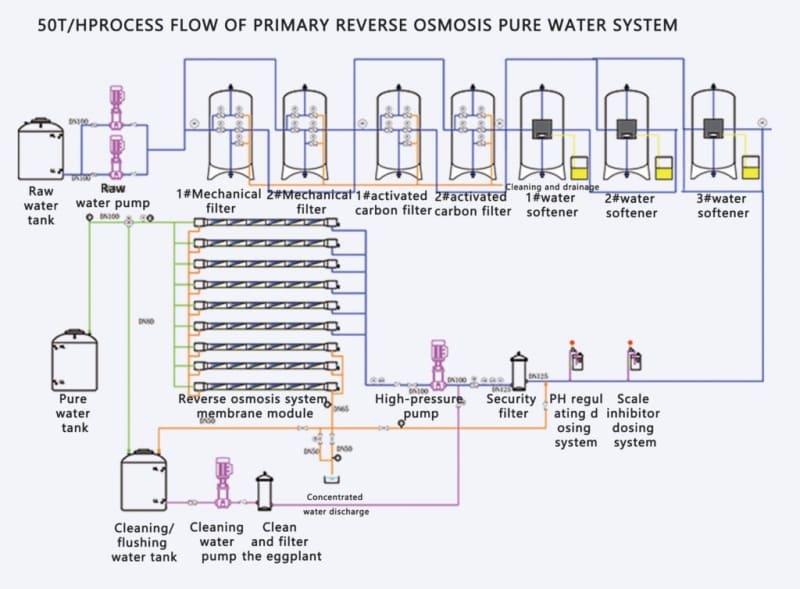
Key Components of a Reverse Osmosis Plant
A reverse osmosis plant consists of several interconnected treatment stages. Each stage performs a specific function and contributes to the overall performance of the system.
A typical industrial RO process may include:
Raw Water → Pretreatment → Security Filtration → High-Pressure Pump → RO Membranes → Post-Treatment → Pure Water Storage
The exact configuration varies according to the source-water quality and the required final-water specifications.
Main RO Plant Components
Common components include:
- Raw water tank
- Feed or booster pump
- Multimedia or sand filter
- Activated carbon filter
- Water softener or antiscalant dosing system, where required
- Cartridge security filter
- High-pressure pump
- RO membrane pressure vessels
- RO membrane elements
- Flow and pressure instruments
- Conductivity monitoring
- Post-treatment equipment
- Pure water tank
- Distribution pump
- PLC and HMI control system
The relationship between these components is often shown through an RO plant diagram or process flow diagram (PFD).
A detailed process diagram helps engineers and operators understand water movement, equipment connections, control points, and maintenance requirements.
Reverse Osmosis Process Explained
Reverse osmosis uses pressure to drive water through a semipermeable membrane.
Under normal osmosis, water moves across a membrane from a lower concentration of dissolved substances toward a higher concentration. Reverse osmosis applies external pressure to reverse this natural movement.
The membrane allows water molecules to pass while rejecting a large proportion of dissolved salts and other contaminants.
The actual rejection performance depends on membrane type, feed-water chemistry, operating pressure, temperature, recovery, and system design.
RO is therefore not simply a mechanical filter with fixed-size openings. It is a membrane separation process influenced by multiple operating conditions.
What Does an RO System Remove?
Depending on the membrane and system configuration, RO can significantly reduce:
- Dissolved salts
- Total dissolved solids (TDS)
- Many dissolved inorganic compounds
- Certain organic compounds
- Microorganisms and other contaminants
A commonly referenced RO membrane rejection rate can approach or exceed 95% for many dissolved substances, with some systems designed for higher overall salt rejection.
Performance should always be evaluated against the manufacturer’s membrane specifications and the actual feed-water conditions.
Pretreatment System Configuration
Pretreatment is one of the most important parts of an RO plant.
The purpose of pretreatment is to condition the feed water before it reaches the RO membranes. Effective pretreatment reduces suspended solids, chlorine, hardness, and other substances that may cause fouling, scaling, or membrane damage.
A typical pretreatment configuration may include:
- Raw water storage
- Feed pumping
- Sand or multimedia filtration
- Activated carbon filtration
- Water softening or chemical dosing where required
- Cartridge security filtration
The actual configuration should be based on a detailed raw-water analysis.
Filtration Stages
Sand or multimedia filters are commonly used to reduce suspended solids and turbidity.
Activated carbon filters can reduce residual chlorine, odors, color, and certain organic compounds.
A cartridge filter provides a final filtration barrier before the RO membrane stage.
Chemical Treatment
Some RO systems require chemical dosing to control scaling or adjust water chemistry.
Depending on feed-water conditions, treatment may include:
- Antiscalant dosing
- pH adjustment
- Dechlorination
- Coagulation
- Water softening
Chemical treatment should be selected based on water analysis rather than applied as a standard configuration to every RO plant.
Monitoring Pretreatment Performance
Monitoring parameters such as pressure differential, turbidity, flow, and chemical conditions helps operators identify pretreatment problems before they affect the RO membranes.
Good pretreatment design can significantly improve membrane service life and reduce cleaning frequency.
Core RO Membrane Technology
The RO membrane is the central separation component of the plant.
Modern systems commonly use thin-film composite (TFC) membranes because of their high rejection performance and suitability for a wide range of applications.
The membrane elements are installed inside pressure vessels. Feed water enters the vessel under pressure, and the membrane separates it into two streams:
- Permeate: treated water passing through the membrane
- Concentrate: water containing a higher concentration of rejected substances
The ratio between these streams is known as recovery.
Factors Affecting Membrane Performance
RO membrane performance depends on:
- Feed-water quality
- Operating pressure
- Water temperature
- Recovery rate
- Membrane condition
- Pretreatment effectiveness
- Cleaning and maintenance
Proper pretreatment is particularly important because membrane fouling and scaling can reduce permeate flow and increase operating pressure.
Membrane Maintenance
RO membranes require regular performance monitoring.
Operators can compare normalized permeate flow, salt rejection, pressure, and conductivity with baseline operating data.
When performance declines beyond acceptable limits, membrane cleaning or replacement may be required.
High-Pressure Pump Systems and Their Role
The high-pressure pump supplies the pressure required for the reverse osmosis process.
Pump selection depends on the required permeate capacity, membrane configuration, feed-water conditions, recovery, and operating pressure.
For lower-pressure RO applications, centrifugal pumps are commonly used. Multistage centrifugal pumps can provide higher pressures where required.
Pump efficiency is important because pumping represents a major portion of the energy consumption of many RO systems.
Key Pump Selection Factors
Important considerations include:
- Required flow rate
- Operating pressure
- Pump efficiency
- Material compatibility
- Motor power
- Control method
- Maintenance requirements
- Spare parts availability
Variable-frequency drives (VFDs) can be used in suitable applications to regulate pump speed and improve operational flexibility.
Regular pump maintenance helps maintain stable pressure and reduces unexpected downtime.
Post-Treatment Process Integration
RO permeate may require additional treatment depending on its final application.
Post-treatment can include:
- UV sterilization
- Ozone treatment
- Remineralization
- pH adjustment
- Polishing filtration
- Final disinfection
- Pure water storage
The correct post-treatment depends on the intended use of the treated water.
For example, water intended for a beverage production process may have different requirements from water used for industrial processes, boiler feed, or laboratory applications.
Pure Water Storage and Distribution
A treated-water tank provides a buffer between RO production and downstream demand.
Storage tanks should be designed according to the required capacity, water quality, hygiene requirements, and distribution system.
Distribution pumps then deliver treated water to the required points of use.
The tank and distribution system should be designed to avoid unnecessary stagnation and maintain the required water quality.
💬 WhatsApp: Learn More & Talk to Our Engineers →
Advanced Control Systems and Automation
Automation can improve the reliability, consistency, and visibility of an RO plant.
A modern control system can monitor operating conditions and provide alarms when parameters move outside defined limits.
Typical monitored parameters include:
- Feed pressure
- RO pressure
- Permeate flow
- Concentrate flow
- Conductivity
- Tank level
- Pump status
- Equipment alarms
PLC and HMI systems can provide centralized control and display important operating information for plant operators.
Predictive Maintenance
Advanced monitoring can also support predictive or condition-based maintenance.
Changes in pressure differential, flow, conductivity, or pump performance may indicate developing problems.
Data from sensors can help operators identify trends and schedule maintenance before a major failure occurs.
However, the value of predictive maintenance depends on the quality of instrumentation, historical data, system design, and maintenance procedures.
Environmental Impact and Sustainability
Energy consumption and concentrate management are important considerations when designing a reverse osmosis plant.
RO requires energy to pressurize the feed water. Improving pump efficiency and using energy-recovery technology where appropriate can reduce energy consumption.
Water recovery is another important factor.
A higher recovery rate means more of the feed water becomes permeate, but pushing recovery too high can increase scaling and fouling risks. The optimum recovery therefore depends on the feed-water chemistry and membrane system.
Sustainability Strategies for RO Plants
Potential strategies include:
- High-efficiency pumps
- Energy-recovery devices for suitable high-pressure applications
- Optimized recovery rates
- Efficient pretreatment
- Reduced chemical consumption
- Water reuse where appropriate
- Responsible concentrate management
- Renewable energy integration where practical
Sustainability should be considered as part of the complete plant design rather than as an isolated feature.
💬 WhatsApp: Learn More & Talk to Our Engineers →
Industrial Applications of Reverse Osmosis Systems
Reverse osmosis systems are used across many industries because they can provide consistent purified water from a wide range of feed-water sources.
Common applications include:
- Drinking water production
- Food and beverage processing
- Pharmaceutical manufacturing
- Electronics manufacturing
- Boiler feed-water treatment
- Industrial process water
- Municipal water treatment
- Wastewater reuse
Industrial RO systems can be configured for different capacities, from relatively small systems to large-scale treatment plants.
The appropriate configuration depends on the source water, required output, product-water specifications, available space, and operating conditions.
Why Industrial RO Systems Are Widely Used
Key advantages include:
- High dissolved-solids rejection
- Consistent treated-water quality
- Modular system design
- Scalable capacity
- Relatively compact footprint
- Integration with automated controls
- Compatibility with multiple pretreatment technologies
RO is often used as one stage within a larger water treatment process rather than as a complete treatment solution by itself.
Quality Assurance and Compliance
Water treatment systems should be designed and operated according to the requirements of their intended application and local regulations.
Quality assurance begins with source-water analysis and continues through pretreatment, RO operation, post-treatment, storage, and final distribution.
Important quality parameters may include:
- Conductivity
- TDS
- pH
- Turbidity
- Microbiological quality
- Specific chemical contaminants
The required limits vary depending on whether the water is intended for drinking, food production, industrial processing, pharmaceutical use, or another application.
For this reason, fixed values should not be treated as universal standards for every RO plant.
Documentation and Process Control
A professional RO project should maintain appropriate technical and operating documentation.
This may include:
- Process flow diagrams
- P&IDs
- Equipment specifications
- Operating procedures
- Maintenance schedules
- Water-quality records
- Calibration records
- Testing reports
Clear documentation improves traceability and helps operators maintain consistent system performance.
Future Innovations in RO Plant Design
Reverse osmosis technology continues to develop as industries seek better efficiency, lower operating costs, and more sustainable water treatment.
Future development is likely to focus on several areas.
Advanced Membranes
New membrane materials and surface technologies may improve salt rejection, permeability, fouling resistance, and energy efficiency.
Improved Pretreatment
Better pretreatment can reduce membrane fouling and scaling while extending membrane operating life.
Potential technologies include advanced filtration, optimized chemical treatment, and improved monitoring.
Intelligent Automation
More advanced sensors, data analytics, and control systems can provide better information about membrane performance, energy use, and maintenance requirements.
Automation can also help operators respond more quickly to changing feed-water conditions.
Energy Efficiency
Energy recovery and high-efficiency pumping technologies will remain important, particularly for larger and higher-pressure RO applications.
Future Benefits
Continued development could provide:
- Improved water quality
- Lower energy consumption
- Longer membrane life
- Reduced maintenance
- Better system reliability
- Lower operating costs
💬 WhatsApp: Learn More & Talk to Our Engineers →
Reverse Osmosis Plant Layout and Design Considerations
A good RO plant layout should consider both the treatment process and long-term operation.
The equipment should be arranged so that water follows a logical treatment path while operators have sufficient access for inspection and maintenance.
Important layout considerations include:
- Raw-water and chemical storage
- Pretreatment equipment
- RO skid location
- Membrane replacement access
- Pump maintenance space
- Electrical and control panels
- Pure-water storage
- Chemical handling areas
- Drainage
- Operator access
- Safety requirements
- Future expansion space
A compact design can reduce installation space, but equipment should never be positioned so closely that maintenance becomes difficult.
Why the RO Plant Diagram Matters
A clear reverse osmosis plant diagram helps engineers, operators, and customers understand the complete system.
A good diagram can show:
- Water flow direction
- Treatment stages
- Pumps
- Filters
- Membrane vessels
- Valves
- Instrumentation
- Storage tanks
- Chemical dosing points
- Control points
For larger industrial projects, a P&ID provides much more detailed information than a simple process illustration.
Conclusion
Reverse osmosis has developed from a specialized desalination technology into a widely used water treatment solution for industrial and commercial applications.
The performance of an RO plant depends on much more than the membrane itself. Pretreatment, high-pressure pumping, membrane selection, recovery, post-treatment, instrumentation, automation, and maintenance all influence system performance.
A well-designed RO plant layout and process flow should be based on the actual source-water characteristics and the required treated-water quality. This helps engineers select the right treatment stages, operating conditions, and equipment configuration.
As membrane technology, automation, energy recovery, and monitoring systems continue to improve, reverse osmosis is expected to remain an important technology for producing reliable purified water while improving energy efficiency and resource utilization.