
Hygiene control is one of the most important factors in beverage production.
During continuous operation, beverage production equipment such as tanks, pipelines, filling machines, and processing systems may accumulate product residues, microorganisms, or contaminants.
A CIP (Clean-in-Place) system provides an efficient cleaning method that removes residues from internal equipment surfaces without requiring complete disassembly.
By using controlled combinations of:
- Water
- Cleaning chemicals
- Temperature
- Flow circulation
a CIP system helps maintain hygienic production conditions and improves cleaning consistency.
CIP technology is widely used in:
- Beverage production lines
- Dairy processing plants
- Food processing systems
- Brewing facilities
- Pharmaceutical manufacturing
- Cosmetic production
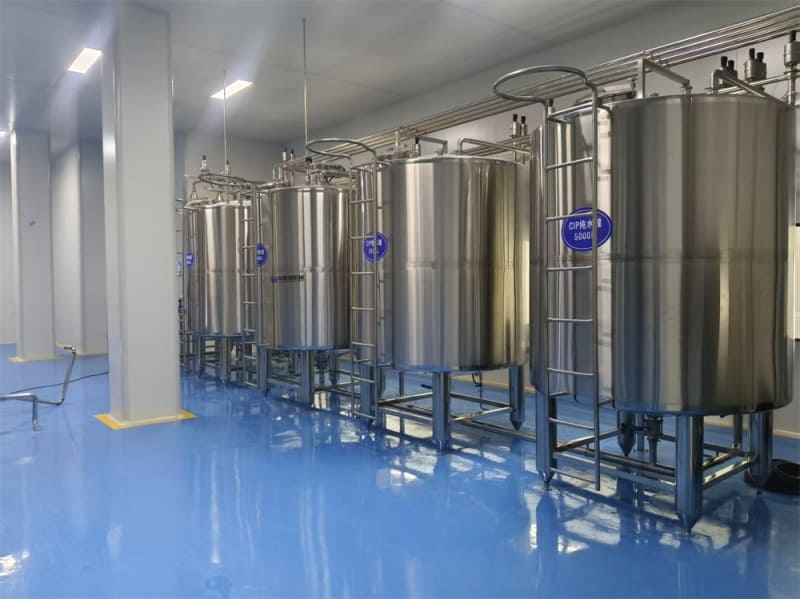
What Is a CIP Cleaning System?
CIP (Clean-in-Place) is a cleaning method that allows production equipment to be cleaned without removing components from the production line.
Instead of manually opening and cleaning equipment, cleaning solutions circulate through:
- Tanks
- Pipes
- Pumps
- Filling systems
- Processing equipment
The cleaning process removes:
- Product residues
- Organic contamination
- Mineral deposits
- Microbial contamination risks
A properly designed CIP cleaning system improves cleaning efficiency while reducing downtime between production batches.
CIP vs COP Cleaning
CIP and COP are two different cleaning approaches used in hygienic production environments.
| Method | Description | Application |
|---|---|---|
| CIP (Clean-in-Place) | Cleaning equipment without disassembly | Tanks, pipelines, enclosed equipment |
| COP (Clean-out-of-Place) | Removing components for separate cleaning | Small parts, removable components |
CIP is mainly used for large fixed equipment, while COP is suitable for components that cannot be cleaned effectively in place.
Many beverage factories combine both methods depending on equipment design and hygiene requirements.
When Is CIP Cleaning Used?
CIP cleaning is commonly performed in the following situations:
Product Changeover
When switching between different products, CIP helps remove previous product residues and reduce cross-contamination risks.
Examples:
- Juice changeover
- Dairy product changeover
- Beverage formula replacement
Scheduled Cleaning
Production facilities normally perform CIP according to:
- Production time
- Product characteristics
- Hygiene requirements
- Industry standards
The cleaning frequency depends on the specific production environment.
CIP Cleaning Process: Six Main Steps
A typical beverage equipment CIP cycle includes six stages:
- Pre-rinse
- Caustic cleaning
- Intermediate rinse
- Acid cleaning
- Sanitization
- Final rinse
The exact parameters should be adjusted according to:
- Equipment design
- Product residues
- Cleaning chemicals
- Sanitation requirements
1. Pre-Rinse
The first stage removes loose product residues from equipment surfaces.
Typical medium:
- Drinking water
- Hot water when required
Purpose:
- Remove remaining beverage
- Prepare equipment for chemical cleaning
A successful pre-rinse normally results in clear discharge water before moving to the next stage.
2. Caustic Cleaning
Caustic washing removes organic residues such as:
- Sugar deposits
- Protein residues
- Fat contamination
Common cleaning chemical:
NaOH (Sodium Hydroxide)
Typical reference conditions:
| Parameter | Range |
|---|---|
| Concentration | 1–2.5% |
| Temperature | 70–90℃ |
| Time | 20–30 minutes |
The actual settings should be adjusted according to the equipment and product characteristics.
3. Intermediate Rinse
After caustic cleaning, clean water is circulated to remove remaining alkaline solution.
Purpose:
- Remove chemical residues
- Prepare equipment for acid cleaning
The rinse continues until the discharged water reaches acceptable conditions.
4. Acid Cleaning
Acid cleaning helps remove:
- Mineral deposits
- Scale
- Alkaline residues
Common chemical:
HNO₃ (Nitric Acid)
Typical reference conditions:
| Parameter | Range |
|---|---|
| Concentration | 0.5–1.5% |
| Temperature | 60–80℃ |
| Time | 15–20 minutes |
Acid cleaning frequency depends on:
- Product type
- Water quality
- Production conditions
5. Sanitization
The sanitization stage reduces microorganisms before production starts again.
Common methods include:
- Peracetic acid (PAA)
- Hot water
- Steam
Example reference:
| Parameter | Value |
|---|---|
| PAA concentration | 0.1–0.2% |
| Temperature | ≥85℃ |
| Time | 10–15 minutes |
6. Final Rinse
The final rinse removes remaining cleaning chemicals or sanitizer.
Usually uses:
- Treated water
- Purified water
Acceptance:
- No detectable chemical residue
- Equipment ready for production
CIP System Types and Main Equipment
CIP systems can be classified according to how cleaning solutions are prepared and reused.
Single-Use CIP System
Fresh cleaning solutions are prepared for each cleaning cycle.
Advantages:
- Simple operation
- Suitable for smaller systems
Reuse CIP System
Cleaning solutions are recovered and reused.
Advantages:
- Reduced water consumption
- Lower chemical consumption
- Suitable for larger production plants
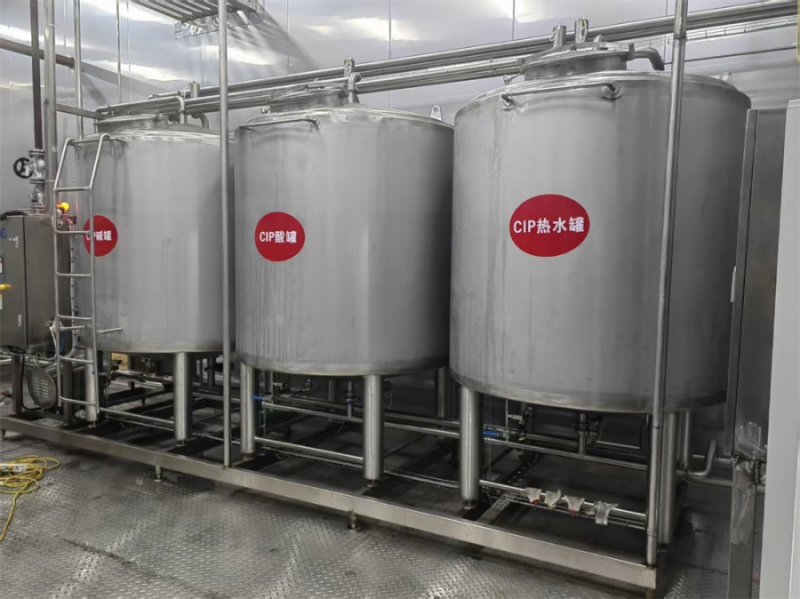
Main Components of an Automatic CIP System
A complete CIP system normally includes:
Cleaning Tanks
Used for storing:
- Acid solution
- Caustic solution
- Hot water
Heating System
A heat exchanger maintains required cleaning temperature.
Pumps
Supply and return pumps circulate cleaning liquids through equipment.
Automatic Valves
Control cleaning routes and flow direction.
Monitoring System
Includes:
- Temperature monitoring
- Conductivity measurement
- pH monitoring
- PLC control system
- Touchscreen operation interface
CIP Cleaning Frequency
Cleaning frequency depends on:
- Product type
- Production schedule
- Hygiene requirements
- Residue characteristics
Reference examples:
| Application | Reference Frequency |
|---|---|
| Dairy | Every 24–48 hours |
| Beverage Production | Every 1–3 days |
| Sauce Production | Several days to one week |
| Product Changeover | Immediately |
These values are general references only. Each factory should establish cleaning schedules according to actual production conditions.
CIP Validation and Quality Control
A CIP system should be monitored and verified to ensure cleaning effectiveness.
Common verification methods include:
Visual Inspection
Check whether discharge water is clear.
pH Testing
Confirm chemical removal after rinsing.
Conductivity Monitoring
Monitor cleaning solution concentration.
ATP Testing
Evaluate surface cleanliness.
Chemical Concentration Testing
Verify acid and caustic concentration.
Common CIP Problems and Solutions
| Problem | Possible Cause | Solution |
|---|---|---|
| Temperature below target | Insufficient heating supply | Check heating system |
| Conductivity remains high | Chemical residue | Extend final rinse |
| ATP result too high | Poor sanitation | Repeat cleaning process |
| Filling valve not cleaned properly | Poor circulation | Use cleaning dummy cups |
CIP Cleaning for Beverage Filling Lines
For beverage filling equipment, CIP cleaning is especially important because filling systems directly contact finished products.
A suitable cleaning system should ensure effective circulation through:
- Filling valves
- Product pipes
- Tanks
- Pumps
For filling valves, cleaning dummy cups are often used to create a sealed circulation path during CIP operation.
This allows cleaning solution to pass through the filling system and remove residues effectively.
Choosing the Right CIP Cleaning Solution
When selecting a CIP system, manufacturers should consider:
Production Scale
Large beverage factories may require automated CIP systems with multiple tanks and recovery functions.
Product Type
Different products create different residues:
- Juice
- Milk
- Carbonated drinks
- Protein beverages
Equipment Structure
The CIP system should match:
- Pipe layout
- Tank design
- Filling equipment
- Processing technology
Zhongyilong CIP Cleaning Solutions
Henan Zhongyilong Machinery Equipment Co., Ltd. provides complete beverage production solutions, including hygienic processing and cleaning systems.
The company supplies solutions for:
- Beverage filling lines
- Juice production lines
- Bottled water production lines
- Carbonated beverage production lines
- Complete turnkey beverage factories
A properly designed CIP cleaning system helps beverage manufacturers improve hygiene control, reduce cleaning time, and maintain stable production.
Conclusion
A CIP cleaning system is an important part of modern hygienic production facilities.
By combining controlled cleaning chemicals, temperature, flow, and monitoring systems, CIP technology allows beverage manufacturers to clean production equipment efficiently without disassembly.
For beverage production lines, selecting the right CIP system helps improve sanitation, reduce downtime, and maintain consistent product quality.
FAQ
What does CIP mean in beverage production?
CIP means Clean-in-Place. It is a cleaning method that removes residues from production equipment without dismantling the system.
What equipment can be cleaned by CIP?
CIP systems are commonly used for tanks, pipelines, pumps, filling machines, and other enclosed processing equipment.
How often should a beverage factory perform CIP cleaning?
The frequency depends on product type, production schedule, and hygiene requirements. Beverage plants commonly perform CIP every 1–3 days as a general reference.
What chemicals are used in CIP cleaning?
Common CIP chemicals include sodium hydroxide (NaOH), nitric acid (HNO₃), peracetic acid (PAA), and water.
Does CIP reduce production downtime?
Yes. Compared with manual cleaning methods, CIP can improve cleaning consistency and reduce time required for equipment preparation.